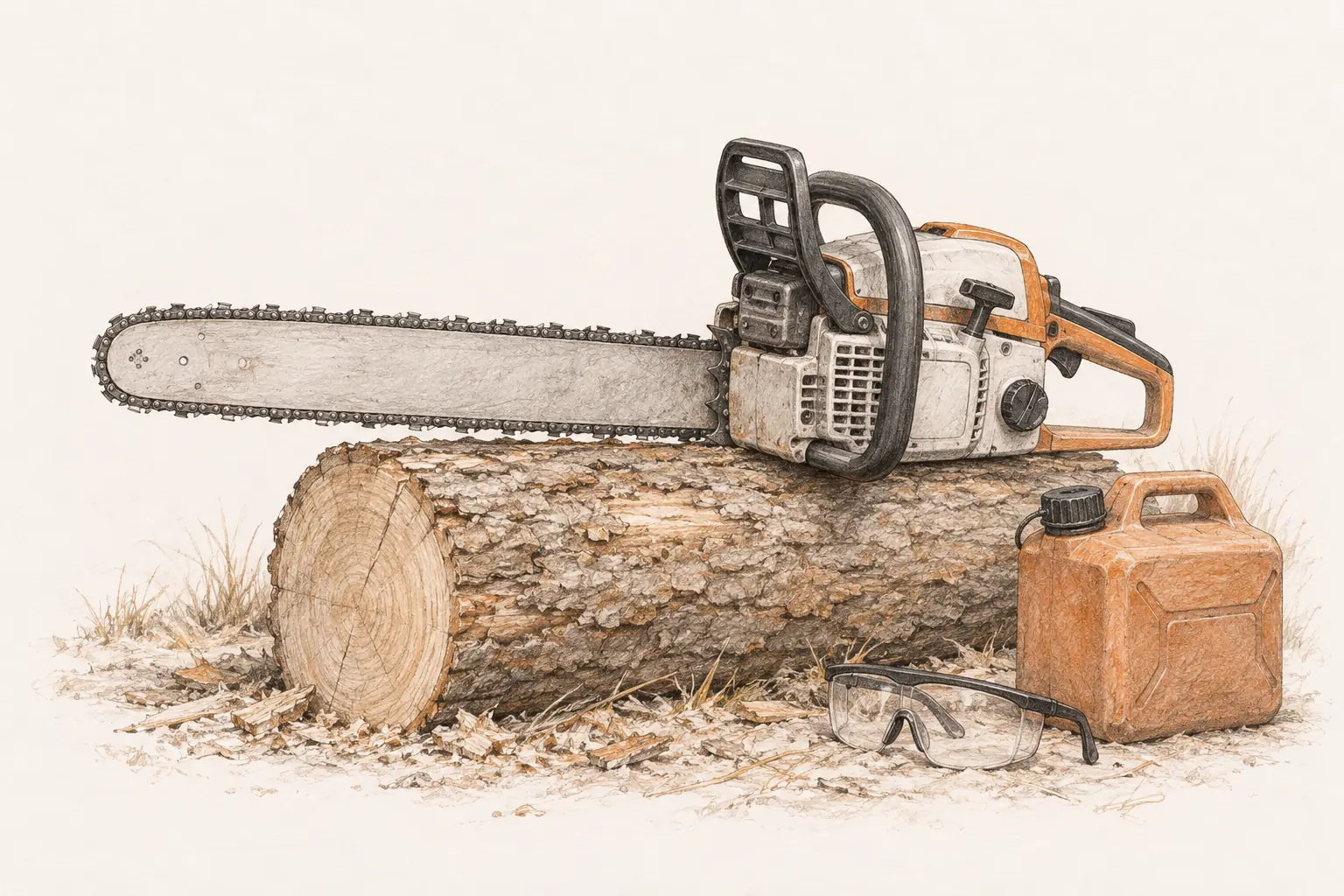
Gas Powered Chainsaw: Best Picks for Firewood and Storm Cleanup
Chainsaws and tree care
The best gas powered chainsaw for most homeowners is the Husqvarna 120 Mark III, a 16-inch saw that starts easy and weighs 10.7 pounds. The PROYAMA 68cc is the one for firewood and bigger trunks, and the VEVOR 25.4cc is the cheap top handle for limbing.
Our picks
The best gas powered chainsaw for most homeowners is the Husqvarna 120 Mark III, and the reason is that it does the common jobs well without the weight of a pro saw. It runs a 16-inch bar, weighs 10.7 pounds, and starts without a fight in the cold. If your jobs are bigger, the PROYAMA 68cc carries a 24-inch bar for less than a name-brand 40cc saw.
This guide sits inside the chainsaw and tree care guides. If you want a saw you never mix fuel for, read our best cordless chainsaw guide. Whichever saw you buy, add chainsaw chaps and a sharpener before the first tank.
Husqvarna 120 Mark III: the best gas chainsaw for most homeowners
The Husqvarna 120 Mark III is the best gas chainsaw for most homeowners. The 38.2cc two-cycle engine makes 1.88 horsepower and turns the chain at 55 feet per second through a 16-inch bar, which is a real step up from a small limbing saw.
Husqvarna built this saw for easy starts. The air purge primes the carburetor before you pull, and the combined choke and stop control cuts the guesswork out of a cold start. The inertia chain brake trips if the saw kicks, and the LowVib handles cut the vibration that wears out your hands on a long session.
The saw holds a 16-inch bar, and Husqvarna rates the 120 for bars between 14 and 18 inches. The automatic oiler feeds the bar and chain as you cut, so there is no oil button to hold. It weighs 10.7 pounds without cutting gear, which keeps it usable overhead on a storm-damaged limb.
Who it is for: Homeowners with storm cleanup, pruning, and a few cords of firewood. Skip it if you fell big hardwood, where a 60cc saw is the right tool.
Shop: Husqvarna 120 Mark III 16-Inch Chainsaw on Amazon
PROYAMA 68cc: the best gas chainsaw for firewood and bigger trunks
The PROYAMA 68cc Gas Chainsaw is the pick when the wood gets big. The 68cc two-cycle engine makes 4.5 horsepower, and the saw ships with both a 20-inch and a 24-inch bar, so one saw covers bucking firewood and felling a medium trunk.
The magnesium alloy crankcase and chain brake keep the weight down and shrug off a knock, and the anti-vibration mounts ease the sting on a long session. The air filter releases with a latch for a quick clean, which is the maintenance step that decides whether a saw keeps starting.
The PROYAMA runs on a 40:1 gas and oil mix, and it burns about a tank in 45 minutes of steady cutting. At 14.5 pounds without fuel it is heavy enough that you will notice it at the end of a cord, which is the honest trade for 4.5 horsepower at this price.
Who it is for: Firewood, storm cleanup, and felling medium trees where 24 inches of reach matters. Skip it if you only prune limbs, where the lighter Husqvarna is easier.
Shop: PROYAMA 68cc Gas Chainsaw on Amazon
VEVOR 25.4cc 12-inch: the best cheap gas chainsaw for limbing
The VEVOR 25.4cc 12-Inch Top Handle Chainsaw is the cheap gas saw for limbing and pruning. The 25.4cc two-cycle engine makes 1.2 horsepower and spins to 8,500 rpm, which is enough for the 12-inch bar to cut a 9.84-inch branch in one pass.
A top handle saw is built to be used close to the body, which is why the wrap-around handle sits on top. The VEVOR weighs 9.26 pounds, so it is light to carry up a ladder or into a thicket. The side chain adjuster works with a standard scrench, and the small 230 ml fuel tank and 160 ml bar-oil tank keep the saw light.
VEVOR asks for a 25:1 mix for the first tank and then 40:1 or 50:1 after break-in. It is a limbing saw, not a felling saw, so keep it on branches under about 10 inches and use a rear handle saw for the trunk.
Who it is for: Pruning, limbing, and brush on a budget, plus a second saw for a homeowner who already owns a bigger one. Skip it if you fell trees, where the grip and short bar are the wrong tools.
Shop: VEVOR 25.4cc 12-Inch Top Handle Chainsaw on Amazon
What bar length do you actually need?
Match the bar to the wood you cut. A bar cuts a log about 2 inches shorter than its length in a single pass, so a 16-inch bar handles a 14-inch log and a 24-inch bar handles about 22 inches. A smaller saw with too long a bar bogs down and cuts slower, not faster.
How bar length maps to trunk size
A saw needs enough displacement to pull the bar through the wood. A 38cc engine is happy on a 16-inch bar, and it starts to labor when you hang a 20-inch bar on it. A 68cc engine pulls a 24-inch bar without slowing, which is why the big saw comes with both a 20-inch and a 24-inch bar and the small homeowner saw tops out at 18 inches.
Why a 12-inch bar is not just a small 24-inch bar
A short bar is built for close work, and the bar length does not change how much power the engine makes. A top handle saw with a 12-inch bar is built to be used one-handed near your shoulder, which is why arborists use it on limbs and why you should never fell a trunk with it. The tip of any bar is the kickback zone, and a short bar moves that tip closer to your body.
What gas mix does a two-cycle chainsaw take?
Most homeowner chainsaws take a 40:1 or 50:1 mix of fresh gasoline and two-cycle oil. VEVOR asks for 25:1 for the first tank, then 40:1 or 50:1 after break-in. Always use fresh, ethanol-free gas, because old mix is the usual reason a saw starts hard.
What a tank of mix costs
A gallon of 50:1 mix is a gallon of gas plus about 2.6 ounces of two-cycle oil, and a gallon of 40:1 mix takes about 3.2 ounces. If you pay about $4 a gallon for ethanol-free gas and about a dollar for the oil, a gallon of mix lands near $5. A small homeowner saw burns a gallon on a long afternoon of light cutting, and a 68cc saw drinks it faster.
The reason to mix small batches is that gas goes stale. Mix only what you will burn in a few weeks, keep it in a sealed can, and run the saw dry before it sits for the season.
Is gas or battery better for a chainsaw?
Choose gas for all-day cutting, big trunks, and storm cleanup where you cannot wait on a charger. Choose battery for a few limbs, a small yard, and anyone who does not want to mix fuel and tune a carburetor. Most homeowners are fine with battery until the trunk passes 12 inches.
A gas saw also cuts through a big trunk with more torque than a battery saw of the same bar length, and it never asks for a charge. The trade is the upkeep. A gas saw wants fresh mix, a clean air filter, and a carburetor that has not sat with old fuel in it, and that maintenance is the real cost of owning one.
How long does a tank of mix last?
A homeowner saw runs about 40 to 60 minutes on a tank of mix, and a bigger 68cc saw lands near the same range because it burns more fuel to make more power, around 45 minutes. Heavy cutting in hardwood drinks fuel faster than light limbing in softwood.
What one tank buys
A tank that lasts 45 minutes covers a lot of firewood when each cut is quick, which is why a bucket of mix outlasts a pickup load of rounds. The mix is not the expensive part of a cutting day. Your time and a sharp chain are, and a dull chain is what turns a one-tank job into a three-tank job.
What does it cost to run a gas chainsaw for a season?
Mix for a season of firewood runs about $20 to $30, plus a gallon of bar and chain oil at about $25, a spare chain, and a spark plug. The real cost of a gas saw is the upkeep, because fresh fuel, a clean filter, and a tuned carburetor are what keep it starting.
A homeowner who cuts a few cords a year should budget for a replacement chain each season, a gallon of bar oil, and a spark plug. Together that lands around $60 to $90 a year on top of the saw, and it is the price of a saw that starts on the second pull next spring instead of the twentieth. Store the saw dry, keep the chain sharp, and the yearly bill stays at the low end.
Bottom line
The Husqvarna 120 Mark III is the best gas powered chainsaw for most homeowners, a 10.7-pound, 38cc saw that starts with an air purge and runs a 16-inch bar. The PROYAMA 68cc is the pick for firewood and bigger trunks with a 4.5-horsepower engine and a 20-inch and 24-inch bar in the box, and the VEVOR 25.4cc 12-inch is the cheap top handle for limbing.
For more tree care coverage, browse the chainsaw and tree care guides, the best log splitter for home use, and the best pole saw for tree trimming.
Frequently Asked Questions
What is the best gas powered chainsaw for a homeowner?
For most homeowners the Husqvarna 120 Mark III is the best gas chainsaw. It is a 38cc, 16-inch saw that weighs 10.7 pounds, starts with an air purge and a combined choke, and handles storm limbs and firewood without the weight of a pro saw. Step up to a 68cc saw only if you cut big trunks.
What bar length do I need on a chainsaw?
Match the bar to the wood. A bar cuts a log about 2 inches shorter than its length in one pass, so a 16-inch bar handles a 14-inch log and a 24-inch bar handles about 22 inches. A small saw with too long a bar bogs down and cuts slowly.
What gas mix does a gas chainsaw take?
Most homeowner two-cycle saws take a 40:1 or 50:1 mix of gas and two-cycle oil. Use fresh, ethanol-free gas, because old mix is the usual reason a saw will not start. VEVOR asks for 25:1 for the first tank and then 40:1 or 50:1 after that.
Is a gas chainsaw better than a battery chainsaw?
Choose gas for all-day cutting, big trunks, and storm cleanup where you cannot wait on a charger. Choose battery for a few limbs, a small yard, and anyone who does not want to mix fuel and tune a carburetor. Most homeowners are fine with battery until the trunk passes 12 inches.
How long does a gas chainsaw run on a tank?
A homeowner saw runs about 40 to 60 minutes on a tank of mix, and a bigger 68cc saw lands near the same range because it burns more fuel to make more power, around 45 minutes. Heavy cutting in hardwood drinks fuel faster than light limbing in softwood.
How much does it cost to run a gas chainsaw?
Mix for a season of firewood runs about $20 to $30, plus a gallon of bar and chain oil at about $25, a spare chain, and a spark plug. The real cost of a gas saw is the upkeep, because fresh fuel, a clean air filter, and a tuned carburetor are what keep it starting.
What is a top handle chainsaw used for?
A top handle saw is built for limbing and pruning, often one-handed up a tree, with a short bar that keeps the tip clear. It is not the saw to fell a trunk with, because the top handle grip and short bar put your hands closer to the cut. Use a rear handle saw for felling.
Do gas chainsaws need ethanol-free gas?
Yes, if you can get it. Ethanol pulls in water as it sits, and a stored saw with ethanol mix is the classic hard-start problem. Use fresh, ethanol-free gas, mix only what you will burn in a few weeks, and run the saw dry before a long storage.