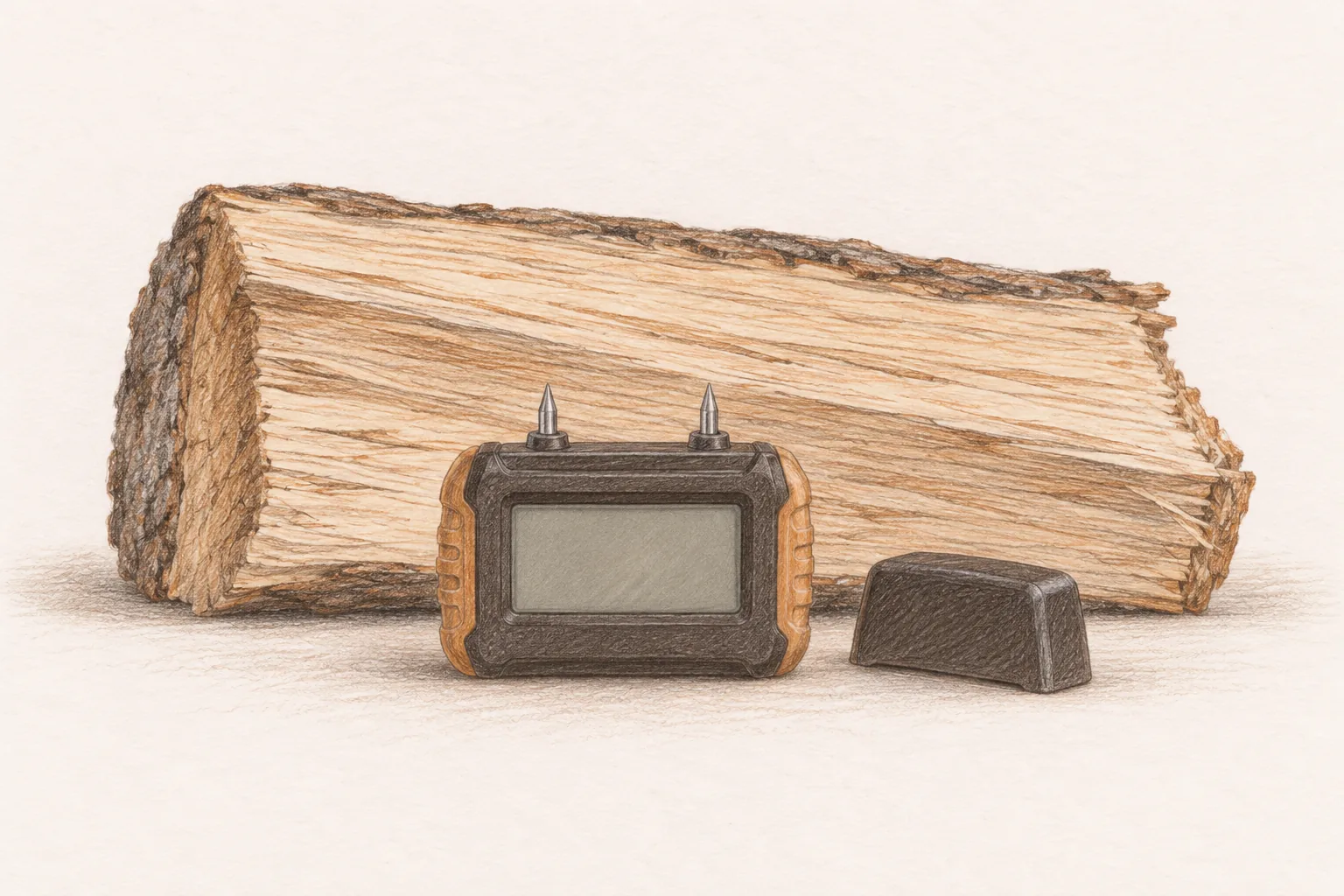
Best Wood Moisture Meter (2026): 3 Picks for Firewood and Lumber
Chainsaws and tree care
The best wood moisture meter is the General Tools MMD4E, a pin meter that checks firewood, lumber, and drywall with a cap that doubles as a calibration check. The Klein Tools ET140 reads pinless through finished wood, and the RDINSCOS MT19B is the budget firewood pick.
Our picks
The best wood moisture meter is the General Tools MMD4E for the usual job: checking whether a split of firewood is dry enough to burn, or whether a board is ready to work. It is a pin meter, so it reads inside the wood rather than across the surface, and the protective cap doubles as a quick calibration check before each session.
The Klein Tools ET140 is the one to buy when you cannot leave pinholes, such as on finished furniture, cabinets, or a wall you are checking for a leak. The RDINSCOS MT19B covers firewood duty for a fraction of the price.
This guide sits inside the chainsaw and tree care guides, alongside the best chainsaw sharpener for keeping the saw cutting and the best log splitter for home use for turning rounds into splits.
What a moisture meter actually measures
Understanding the mechanism saves you from misreading the number.
A pin meter does not measure water directly. It measures electrical resistance between the two pins, and wet wood conducts electricity better than dry wood. The meter converts that resistance into a moisture percentage using a built-in calibration table, which is why different wood species and different depths can shift the reading.
That has two practical consequences. First, pushing the pins in deeper samples more and wetter wood, so the number climbs. Long-term firewood users learn to test the same way every time and to trust the trend more than the absolute figure. Second, a dry outer surface on a split can read low while the core is still wet, which is why you split a piece before you check it.
A pinless meter works differently. It sends an electromagnetic field into the material and averages a shallow zone, which is why it never marks the surface but also why it gives relative readings rather than precise percentages.
Top pick: General Tools MMD4E pin meter
The General Tools MMD4E is the best wood moisture meter for most homeowners. It is a pin-type meter with a 5 to 50 percent range for wood and 1.5 to 33 percent for building materials, plus audible and visual alerts for high, medium, and low moisture.
The protective cap doubles as a calibration checker, which is the feature that separates it from cheaper meters. The display shows moisture percentage directly with large digits and a backlight. It ships with a 9V battery and spare pins are available separately, which matters because pins are the part that wears out.
Who it is for: Firewood cutters, woodworkers, and homeowners checking for leaks or drying lumber. Skip it if you need species-corrected accuracy for professional drying, where a meter with species settings and a slide hammer is the right tool.
Shop: General Tools MMD4E Moisture Meter on Amazon
Best pinless: Klein Tools ET140
The Klein Tools ET140 is the best pinless moisture meter for finished surfaces. It uses an electromagnetic field to detect relative moisture up to 3/4 inch below the surface, so you can check drywall, masonry, hardwood, and softwood without touching the finish.
It is calibrated for those four materials, so switch to the right mode before you trust a reading. It is compact and pocket sized, which makes it easy to carry on an inspection. Woodworkers who dry lumber in quantity generally want more precision than the ET140 offers, but for leak checks and quick "wet or dry" calls it is exactly right.
Who it is for: Home inspectors, homeowners chasing a leak, and woodworkers checking a finished board without marking it. Skip it if you need exact percentages inside a firewood split, where a pin meter is the better tool.
Shop: Klein Tools ET140 Pinless Moisture Meter on Amazon
Best budget: RDINSCOS MT19B firewood meter
The RDINSCOS MT19B is the best cheap wood moisture meter for firewood. It is a pin-type meter with separate hardwood and softwood modes, a backlit LCD, and an audible alarm when moisture is above the safe threshold.
For a homeowner checking a cord or two of firewood each fall, this is all the meter you need. It also handles basic lumber and woodworking checks. Treat the pins gently and store it out of the weather and it will last several seasons.
Who it is for: Firewood burners who want a simple go/no-go check before loading the stove. Skip it for professional lumber drying, where a meter with species calibration and a slide hammer belongs.
Shop: RDINSCOS Wood Moisture Meter on Amazon
How to check firewood without fooling yourself
The meter is only as good as the sample you take.
- Split a piece before you test it. The outside of a log dries first and reads low while the core stays wet. Check the freshly exposed inside face.
- Test more than one split. Moisture varies through a stack, so check several pieces from different spots before you trust a cord.
- Push the pins in the same way every time. Deeper pins read higher. Consistency is what makes your numbers comparable.
- Target under 20 percent. Below that line, wood burns hot and clean. Above it, expect smoke, hissing, and creosote.
- Re-check a few weeks later. A reading over the line usually just means more drying time, not a spoiled cord.
Reading the number: what is dry, and what is not
Different jobs have different targets, and a moisture meter is useful only if you know the line you are aiming at.
For firewood, under 20 percent is the goal. Wood at 25 to 30 percent will burn if you keep a hot fire going, but it wastes energy boiling off water and deposits more creosote in the chimney. For rough framing lumber, 15 to 19 percent is the normal target, because framing dries further once the building is closed in. For furniture-grade lumber, 6 to 8 percent is where you want to be before milling, so the wood does not move after assembly.
If your reading is above the target, the fix is almost always time and airflow rather than a different tool. Restack with more space, keep it off the ground, and top-cover it so rain runs off but air still moves through.
Who should skip a dedicated moisture meter
A moisture meter is a small tool with a specific job, and not everyone needs one.
- You buy kiln-dried firewood. If it arrives under 20 percent, you can skip the meter until your supplier changes.
- You only build with pre-dried lumber from a dealer. The dealer already checked it.
- You want to find a hidden leak. A pinless meter helps, but a leak detector or a moisture survey is the right first step.
- You need lab-grade numbers for a business. A professional meter with species calibration and a slide hammer is the entry point.
For a homeowner with a woodpile, a small pin meter pays for itself the first time it stops you from burning a wet cord.
Bottom line
The General Tools MMD4E is the best wood moisture meter for most people, because its pins read inside the wood, its cap doubles as a calibration check, and it handles firewood, lumber, and drywall. The Klein Tools ET140 is the pinless pick for finished surfaces and leak checks, and the RDINSCOS MT19B is the budget meter for firewood season.
For the rest of the tree-care setup, browse the chainsaw and tree care guides, the best chainsaw sharpener, and the best log splitter for home use.
Frequently Asked Questions
What is the best wood moisture meter for firewood?
A pin meter is the best choice for firewood because it reads resistance inside the split. The General Tools MMD4E is the most popular pick, and the RDINSCOS MT19B is a solid budget option with an audible alert. Split a piece and check the fresh inside face, not the weathered outside.
What moisture content should firewood be for burning?
Seasoned firewood is generally below 20 percent moisture content. Wood above that burns smoky, hisses, and coats the chimney with creosote. A pin meter tells you whether a split is ready or needs another few weeks in the stack.
What is the difference between a pin and a pinless moisture meter?
A pin meter drives two probes into the material and reads resistance, which gives a local reading at the pins. A pinless meter measures with an electromagnetic field and reads a shallow averaged zone without marking the surface. Pin meters suit firewood and lumber; pinless meters suit finished boards, drywall, and leak checks.
Why does my meter read higher when I push the pins in deeper?
A pin meter measures electrical resistance, and wetter wood conducts better. Deeper pins sample more and wetter wood, so the reading climbs. Push the pins in the same way every time so your readings are comparable, and split a piece to confirm the core.
Can I use a wood moisture meter on drywall and concrete?
Yes, most pin meters have a building-materials mode for drywall, plaster, and concrete. The scale is different from the wood scale, so switch modes before you trust the number. Pinless meters like the Klein ET140 are calibrated for drywall, masonry, and wood.
How accurate are inexpensive moisture meters?
Budget pin meters are generally accurate within a couple of percent in the middle of their range and less reliable near the ends. Independent testing found readings below about 8 percent and above about 17 percent drift. For firewood, that is fine because you only care about the line near 20 percent.
How do I check firewood moisture before burning?
Split a log, press the pins into the freshly exposed face, and read the number. Test a few splits from different parts of the stack, because the outside dries first. If the reading is over 20 percent, stack it another few weeks with airflow.