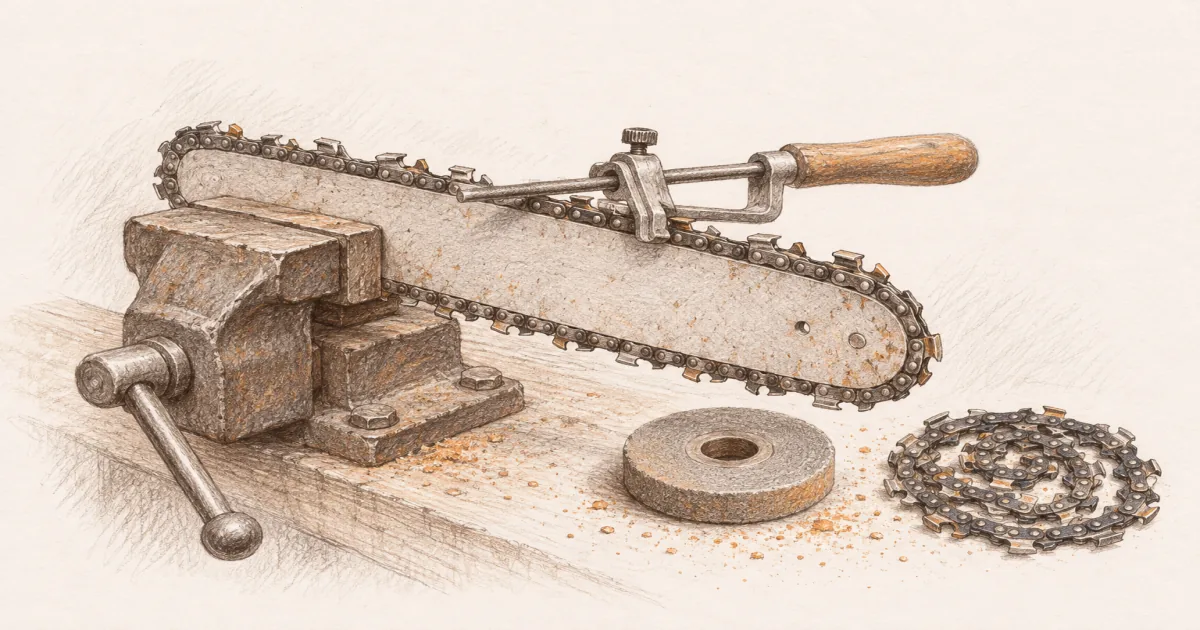
Best Chainsaw Sharpener (2026): 3 Picks for a Sharp Chain
Chainsaws and tree care
The best chainsaw sharpener is the Sharp Pebble electric kit, which grinds every tooth at a set angle in minutes. The STIHL 2-in-1 Easy File sharpens cutters and depth gauges by hand, and the Oregon 410-120 bench grinder handles high volume.
Our picks
The best chainsaw sharpener is the one you will actually use, and for most homeowners that is the Sharp Pebble electric kit. It clamps the chain, sets the angle once, and cycles through the teeth, so the result is even without freehand skill.
A sharp chain is the cheapest performance upgrade a saw can get: it cuts faster, uses less fuel, and is safer because you are not forcing a dull saw. The STIHL 2-in-1 Easy File is the compact hand-tool pick for field touch-ups, and the Oregon 410-120 is the bench tool for a woodpile habit.
This guide sits inside the chainsaw and tree care guides, alongside the best cordless chainsaw and the best pole saw for tree trimming.
Why a sharp chain is the cheapest upgrade you can make
A dull chain does not just cut slowly. It makes you push, which makes you tired, which makes accidents more likely.
Three things happen when a chain goes dull. The saw throws fine dust instead of chips, so you know the cut is grinding rather than slicing. The cut curves to one side, because the teeth on one side are duller than the other. And the engine works harder, running hotter and burning more fuel for less wood.
A five-minute touch-up fixes all three. That is why the tool matters more than the saw for most homeowners: any sharp chain on a modest saw outcuts a dull chain on an expensive one.
Top pick: Sharp Pebble electric chainsaw sharpener
The Sharp Pebble Electric Chainsaw Sharpener Kit is the best chainsaw sharpener for a homeowner. It is a 120V electric unit with an angle-guide attachment, a wrench, and four grinding-wheel sizes: 5/32, 3/16, 7/32, and 7/32 inch, which covers the common chain pitches.
Setting the angle once lets you cycle the chain and grind every tooth to the same depth and angle, which is the difference between a chain that cuts straight and one that wanders. The ergonomic handle works for left- and right-handed users. It is the top seller in its category for a reason.
Who it is for: Homeowners with one or two saws who want an even chain without learning to freehand file. Skip it if you sharpen in the field far from power, where the STIHL file is better.
Shop: Sharp Pebble Electric Chainsaw Sharpener Kit on Amazon
Best hand file: STIHL 2-in-1 Easy File
The STIHL 2-in-1 Easy File is the best manual chainsaw sharpener. It sharpens the cutter and lowers the depth gauge in a single stroke, which keeps the chain cutting aggressively without a second tool.
The kit includes two round files, one flat file, and the holder and guide. It has no moving parts and nothing to plug in, so it goes to the woodpile with you. Match the file to your chain pitch, which is stamped on the depth gauge.
Who it is for: Occasional users, field touch-ups, and anyone who wants a compact kit. Skip it if you have skip-tooth chain or you want the speed of an electric grinder.
Shop: STIHL 2 in 1 Easy File on Amazon
Best for high volume: Oregon 410-120 bench grinder
The Oregon Professional Compact 120V Bench Grinder 410-120 is the best chainsaw sharpener if you deal with a lot of chain. It sharpens up to .404-inch pitch and mounts to a bench or wall with the included hardware.
The kit includes three vitrified grinding wheels, a dressing brick, a quick template, and a manual chain-clamping vise, plus a built-in light. The motor is single-phase, direct-drive, one-way, so debris is thrown away from the operator. It is about 17 pounds, so it lives in the shop.
Who it is for: Firewood cutters, storm cleanup, and anyone with several saws or badly damaged chains. Skip it if you sharpen one chain twice a year, where a file or the electric kit is simpler.
Shop: Oregon 410-120 Bench Grinder on Amazon
Three things to check before you sharpen
A little prep keeps you from sharpening the wrong thing.
Match the file or wheel to the chain pitch. The number stamped on the depth gauge tells you the pitch. Common sizes are 5/32 inch for 3/8 low-profile and 1/4-inch chain, 3/16 inch for .325, and 7/32 inch for 3/8 and .404. Using the wrong size ruins the tooth profile.
Find your sharpening angle. Most chains use a 30-degree top-plate angle, and a few rapid or hexa chains use 25. Check your chain maker's spec and set the tool once.
Check the depth gauges. The depth gauge controls how much wood each tooth takes. It needs to drop as the cutter wears, which is exactly what the STIHL 2-in-1 does automatically. Let them ride too high and the chain stops cutting; take them too low and it grabs.
How to sharpen without wrecking the chain
The technique is short and the same whether you file by hand or grind.
- Clamp the bar. Put the bar in a bench vise or stump vise, and never clamp the chain itself.
- Sharpen the dullest tooth first. Find it, mark it, and use it as your reference for the rest.
- Keep the angle steady. Let the guide do the work. Do not rock the file or the wheel into the tooth.
- Three strokes per tooth is usually enough. A very worn tooth takes more; do not over-grind to save time.
- Alternate sides. Sharpen every tooth on one side, then flip the saw or guide and do the other side to the same length.
- Check the result. A sharp chain pulls into the wood and throws chips. If it still throws dust, touch it up again.
When to stop sharpening and replace the chain
Sharpening only works until the teeth are worn short.
Replace the chain when the cutters are worn back close to the depth gauge, when a cutter has broken or chipped, or when the chain has stretched enough that it no longer tensions properly. A chain that will not hold an edge after a clean sharpen is done. Chains are inexpensive compared with a ruined bar or an overheated saw, so do not baby a worn one.
Bottom line
The Sharp Pebble Electric Chainsaw Sharpener Kit is the best chainsaw sharpener for most homeowners, because its angle guide keeps every tooth even and it restores a chain in minutes. The STIHL 2-in-1 Easy File is the compact hand-tool pick, and the Oregon 410-120 handles high volume and damaged chains.
For the cutting side, see the best cordless chainsaw and the best pole saw for tree trimming, and browse the chainsaw and tree care guides.
Frequently Asked Questions
How often should I sharpen a chainsaw chain?
Sharpen when the saw starts throwing dust instead of chips, when it pulls to one side, or when you have to push to cut. Many pros touch up a chain every tank of fuel. In clean wood, that can mean every few hours; in dirty or frozen wood, much sooner.
What is the best way to sharpen a chainsaw chain?
For most homeowners, an electric sharpener with an angle guide is the easiest way to keep every tooth even. For occasional users who want a compact kit, a file guide like the STIHL 2-in-1 does the same job by hand. A bench grinder is the best option if you sharpen often or bring back damaged chains.
What size file does my chainsaw chain need?
Match the file to the chain pitch. Common pairings are 5/32 inch for 3/8 low-profile and 1/4-inch chain, 3/16 inch for .325-inch chain, and 7/32 inch for standard 3/8 and .404-inch chain. The number stamped on the depth gauge tells you the pitch if you are not sure.
What angle should I sharpen a chainsaw chain at?
Most chains use a 30-degree top-plate angle, with some rapid or hexa chains at 25 degrees. Check your chain manufacturer's spec. The important thing is not the exact number so much as keeping every tooth at the same angle and depth, which is what an angle guide gives you.
Is it better to sharpen a chain or replace it?
Sharpen until the teeth are worn short or a cutter breaks, then replace. A chain that has been sharpened many times loses its depth-gauge height and becomes grabby or cuts crooked. If a chain will not hold an edge after a proper sharpen, it is done.
Can I sharpen a chainsaw chain with a drill?
You can with a dedicated rotary sharpening attachment, but it is easy to remove too much material and ruin the tooth profile. If speed matters, an electric sharpener with a guide is a safer choice. Freehand with a drill is the fastest way to an uneven chain.
How do I know when my chain is sharp?
It pulls itself into the wood and throws chips, not dust. A sharp chain cuts straight with light pressure. If you have to lean on the saw or the cut curves, stop and touch up the chain before you burn the bar or the engine.