Best Lawn Sprinkler Heads (2026): 2 Picks for Even Coverage
Garden and lawn care
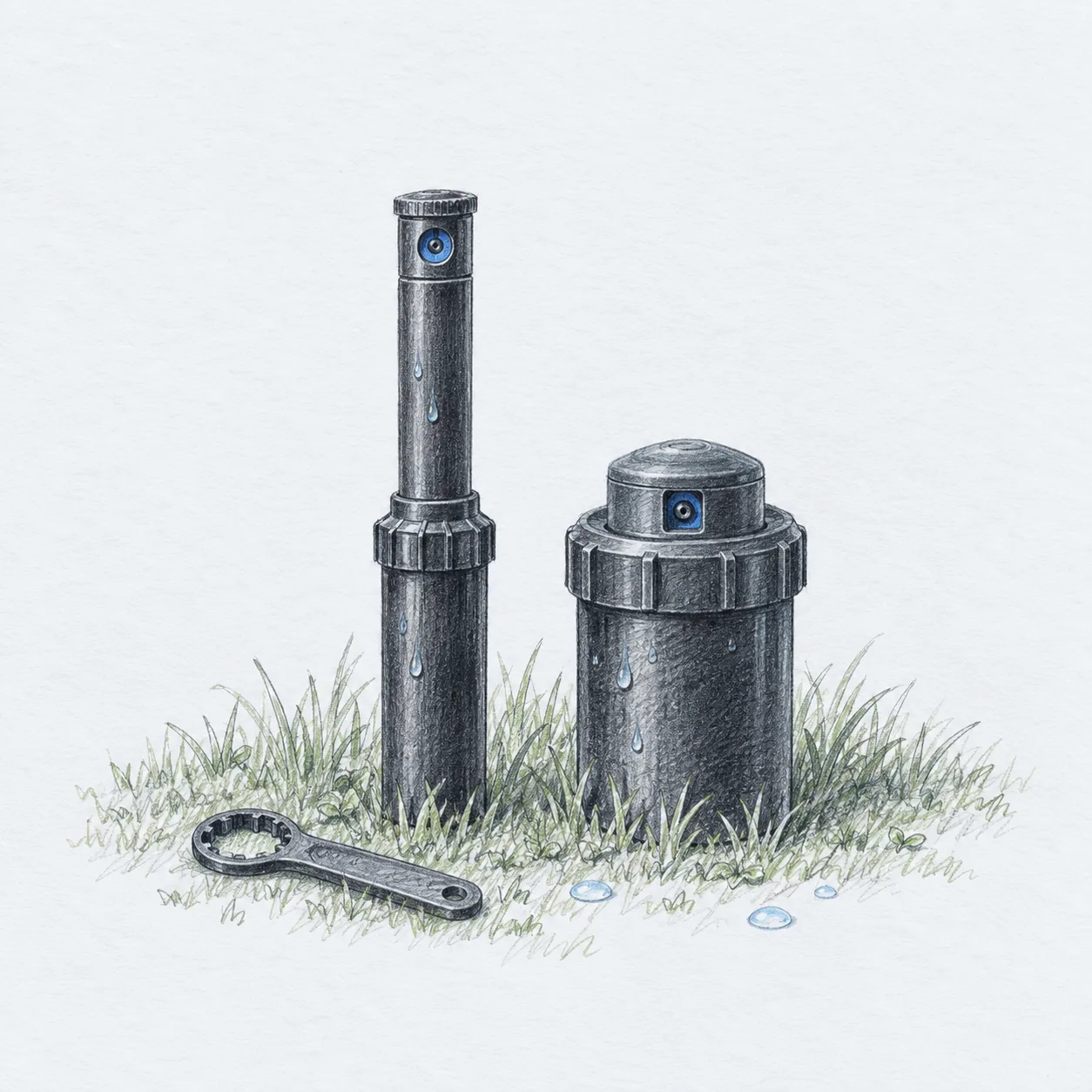
The best lawn sprinkler heads are the Rain Bird 1804VAN pop-ups for spray zones and the Hunter PGP-ADJ rotors for larger lawns. Here is how to match a head to your zone and pressure.
Our picks
The best lawn sprinkler heads depend on the zone in front of you. For narrow strips, corners, and small grass areas, the Rain Bird 1804VAN pop-up spray head is the pick, with an adjustable arc that lets you stop water before it reaches the sidewalk.
For a big open lawn, the Hunter PGP-ADJ rotor is the better tool. One head throws 22 to 52 feet, so fewer heads cover more ground, and the gear drive turns quietly and evenly.
This guide sits inside the garden and lawn care guides, next to the best lawn sprinkler for large yard for portable sprinklers and the best soaker hose for garden for beds and rows.
Spray heads versus rotors: pick by zone size
Two head types cover most home irrigation, and they are not interchangeable within one zone.
Spray heads throw a fan of water a short distance, usually 8 to 15 feet. They are ideal for small lawns, parkway strips, and tight corners where you need precise coverage.
Rotors throw a single stream that sweeps back and forth, reaching 22 to 52 feet. They suit big lawns because one rotor replaces several spray heads, which keeps the zone count and water use down.
Do not mix them in one zone. Spray heads put out water much faster than rotors, so a mixed zone either floods or starves part of the lawn. Keep each zone to one head type.
Top pick: Rain Bird 1804VAN pop-up spray head
The Rain Bird 1804VAN Pop-Up Sprinkler Head is the best lawn sprinkler head for small and mid-size zones. It is a 4-inch pop-up with a fixed spray and a variable arc nozzle that adjusts from 0 to 360 degrees, with a spray distance up to 15 feet.
The head is built for long service. A heavy-duty stainless steel spring helps ensure flush retraction every time, and the wiper seal resists grit and pressure. The textured adjustment collar is easy to grip, even when wet.
Matched precipitation means the head can be combined with other Rain Bird fixed and adjustable sprays in the same zone. The 1/2 inch female threaded inlet fits standard risers, and the mesh filter screen keeps the nozzle clear.
Who it is for: Small lawns, corner beds, and narrow strips where precise, short-radius coverage matters. Skip it for a wide-open lawn, where a rotor covers more ground per head.
Shop: Rain Bird 1804VAN Pop-Up Sprinkler Head on Amazon
Best for large lawns: Hunter PGP-ADJ rotor
The Hunter PGP-ADJ Rotor Lawn Sprinkler Head is the best sprinkler head for a large lawn. It is a gear-drive rotor that throws 22 to 52 feet, so fewer heads cover more grass.
The arc adjusts from 40 to 360 degrees, and the water-lubricated gear drive turns quietly and wears slowly. The 3/4 inch inlet fits standard systems, and the head comes with a preinstalled nozzle.
Adjustment takes the Hunter wrench or a 3/32 inch Allen key. The right stop is fixed, and the wrench changes the left stop by about 90 degrees per full turn. Adjust the radius with the head running so you can see the reach.
Who it is for: Big, open lawns where long throw and even coverage matter. Skip it for tight corners and small strips, where a spray head fits better.
Shop: Hunter PGP-ADJ Rotor Sprinkler Head on Amazon
Matching a head to your water pressure
Pressure decides how a head performs, and too much of it causes the misting and drift people blame on the head.
If your lawn has misting heads, check pressure before replacing anything. A regulator often fixes the pattern for less than a new set of heads.
How to replace a sprinkler head without digging up the line
Replacing a head is a weekend job if the fitting is sound.
- Shut off the zone and mark the spot. Dig a ring around the head, leaving the line below undisturbed.
- Unscrew the old head. Turn it by hand or with a small wrench on the body, not the turret.
- Flush the line. Run the zone for a few seconds to blow grit out before installing the new head.
- Thread the new head on by hand. Hand tight is enough. Over-tightening cracks the fitting.
- Set the top even with the soil. A head set too low cannot pop above the grass.
- Adjust the arc and radius while it runs. Watch the pattern and tune until the spray stops at the edge of the lawn.
If the fitting spins or the line is brittle, stop and call a pro before you crack a pipe.
Who should call an irrigation pro
- You are adding a whole new zone. Running pipe and wiring is a bigger job than swapping heads.
- You have low pressure across the system. That is a design problem, not a head problem.
- A fitting is broken below the head. Digging up a main line risks a bigger leak.
- You want smart scheduling. A controller upgrade is its own project.
For most homeowners, replacing worn heads like for like is the easy win. Designing a system from scratch is where professional help pays off.
Bottom line
The Rain Bird 1804VAN is the best lawn sprinkler head for small and mid-size zones, with an adjustable arc and reliable retraction. The Hunter PGP-ADJ Rotor is the best head for a large lawn, with a long throw and quiet gear drive.
For portable coverage over a big yard, see the best lawn sprinkler for large yard. For beds and rows, the best soaker hose for garden is a better fit. More guides are in the garden and lawn care section.
Frequently Asked Questions
What are the best lawn sprinkler heads?
The Rain Bird 1804VAN is the best pop-up spray head for small and mid zones, thanks to its 0 to 360 degree adjustable arc and tough retraction spring. The Hunter PGP-ADJ is the best rotor for large lawns, throwing 22 to 52 feet per head with smooth gear-drive rotation.
Should I use spray heads or rotors?
Match the head to the zone. Spray heads cover a short radius, about 8 to 15 feet, and suit small or oddly shaped areas. Rotors throw much farther, 22 to 52 feet, so they cover big open lawns with fewer heads. Do not mix spray heads and rotors in the same zone.
How far apart should sprinkler heads be spaced?
Set spray heads about 15 to 20 feet apart so the spray from one head reaches the next, which is called head-to-head coverage. Space rotors by their throw distance, often 25 to 40 feet apart. Even spacing matters more than the exact number.
How do I replace a sprinkler head?
Dig around the head, unscrew it from the fitting, and screw the new head on by hand. Flush the line briefly before installing so grit does not clog the new nozzle. Keep the head level with the soil so the pop-up clears the grass.
Why is my sprinkler head misting instead of spraying?
Misting usually means too much pressure for the nozzle. A pressure-regulating head or a regulator on the zone fixes it. Fine mist also drifts in wind, so water the lawn on calm mornings when you can.
Can I adjust a sprinkler head without tools?
The Rain Bird 1804VAN adjusts its arc with the textured collar and can be fine-tuned with a flathead screwdriver. The Hunter PGP-ADJ needs the Hunter adjustment wrench or a 3/32 inch Allen key. Adjust rotors while they are running so you can see the pattern.
How many sprinkler heads does my lawn need?
It depends on the zone size and the head's throw. For a rough count, divide each zone by the coverage radius and space heads so their sprays overlap. A big lawn usually splits into several zones so pressure stays steady across all the heads.