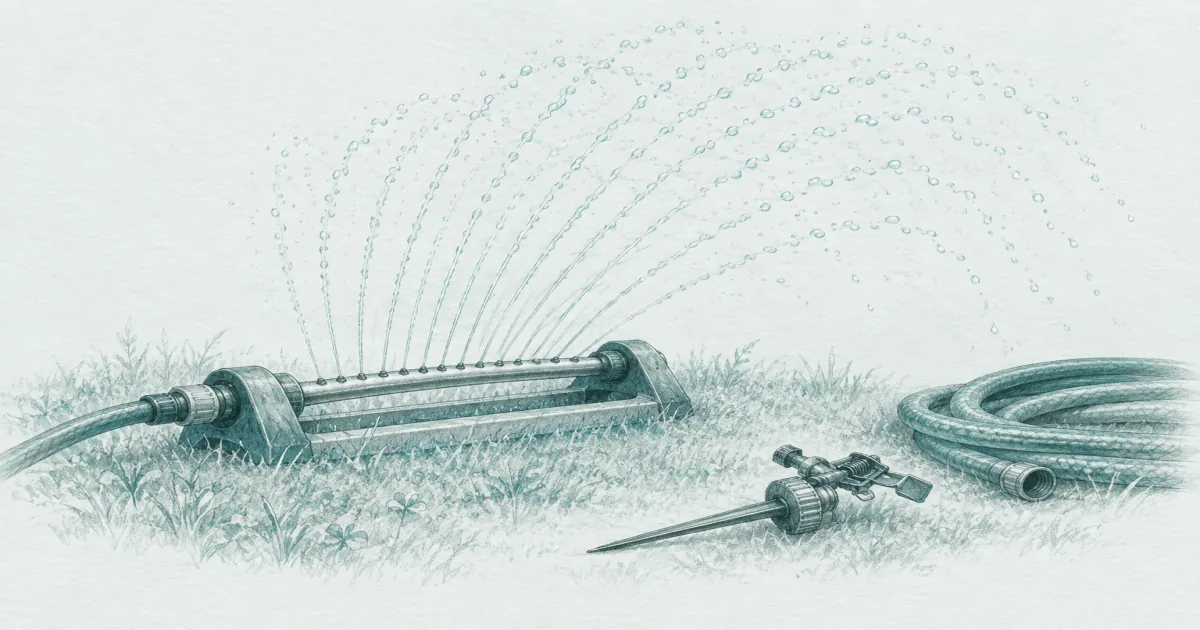
Best Lawn Sprinkler for Large Yard (2026): 3 Picks That Cover It
Garden and lawn care
The best lawn sprinkler for a large yard is the Melnor XT oscillating sprinkler, which covers about 4,200 square feet of even spray on household pressure. The Melnor MiniMax spike reaches beds and corners, and the Eden 96213 covers 3,600 square feet for less.
Our picks
The best lawn sprinkler for a large yard is the Melnor XT oscillating sprinkler for the usual case: an open rectangle of turf, decent household pressure, and a homeowner who wants one pass to soak it evenly. It throws water more than 25 feet in each direction in testing, which is enough to reach the middle of most suburban lawns from one spot.
The Melnor MiniMax on a spike is the one to grab when the lawn is broken up by beds and walkways, and the Eden 96213 is the sub-$25 workhorse.
This guide sits inside the garden and lawn care guides, alongside the best garden hose reel for keeping the hose tidy and the best expandable garden hose for storage. If your beds need water too, the best lawn aerator guide covers opening the soil before you soak it.
What a large yard actually demands from a sprinkler
Three things separate a sprinkler that works on a big lawn from one that just makes a puddle.
Throw distance. A big lawn needs water to reach 25 feet or more from the head. Oscillating sprinklers throw a wide fan; impact sprinklers throw a tighter, farther jet. If your lawn is wider than it is long, an oscillating pattern reaches the corners better than a small rotating head.
Adjustability. The difference between watering the lawn and watering the driveway is being able to narrow the fan. TwinTouch-style controls set each half of the pattern separately, so you can pull one side in around a flower bed.
Pressure tolerance. Most household spigots run 40 to 60 PSI, which is plenty for an oscillating sprinkler. Below 30 PSI, choose an impact model instead. A sprinkler run on weak pressure throws a short, misty fan that mostly feeds the wind.
Top pick: Melnor XT Turbo Oscillating Sprinkler
The Melnor XT Turbo Oscillating Sprinkler is the best pick for a large, mostly rectangular lawn. Its 20 nozzles cover up to 4,500 square feet, and independent testing measured more than 25 feet of throw in each direction on a standard spigot, or roughly 4,200 square feet of real coverage.
TwinTouch controls set the width of each half of the spray, and the Zoom control changes the overall area, so the same sprinkler waters a narrow strip of new seed or a wide-open yard. The quick-connect fitting and limited lifetime warranty are nice bonuses. It is a plastic body, so treat it like one.
Who it is for: Homeowners with a rectangular front or back lawn and normal water pressure who want one sprinkler to cover it. Skip it on low pressure or on a lawn shaped like a crescent.
Shop: Melnor XT Turbo Oscillating Sprinkler on Amazon
Best for beds and corners: Melnor MiniMax on a step spike
The Melnor MiniMax Turbo Oscillating Sprinkler on Step Spike is the pick when the yard is not a clean rectangle. It covers up to 4,000 square feet, but the reason to buy it is the rotating head.
The step spike drives into the lawn and holds firm, and the flo-through base lets you daisy-chain a second unit for a long border. The drive is built to tolerate the grit in well water, same as the XT.
Who it is for: Yards broken up by planting beds, walkways, or a curved border. Skip it if you truly just need one big rectangle covered, where the XT throws farther.
Shop: Melnor MiniMax Turbo Oscillating Sprinkler on Amazon
Best budget: Eden 96213 weighted oscillating sprinkler
The Eden 96213 Weighted Essential Oscillating Sprinkler is the best lawn sprinkler under $25. Its 16 nozzles cover up to 3,600 square feet, which is enough for a typical front lawn, and the weighted base resists tipping on uneven ground.
It ships with a quick-connect bundle and stainless filters, and the built-in cleaning tool keeps the nozzles clear. Eden has sold thousands of these, so parts and replacements are easy to reason about.
Who it is for: A first sprinkler, a second sprinkler for the side yard, or a big lawn on a tight budget. Skip it if you need maximum throw distance, where the Melnor XT is stronger.
Shop: Eden 96213 Weighted Essential Oscillating Sprinkler on Amazon
Matching a sprinkler to your water pressure
Pressure decides which type of sprinkler makes sense, and it is the number most buyers never check.
At 40 to 60 PSI, an oscillating sprinkler gives you the widest, most even coverage. At 30 PSI or below, the same sprinkler throws a short, narrow fan that misses the outer lawn. That is when an impact or pulsating sprinkler earns its place, because it is designed to run on lower pressure and still throw water 30 feet or more.
You can measure your spigot pressure with an inexpensive gauge that screws onto the hose bib. It is worth the few dollars, because it tells you whether to buy the sprinkler you want or the one your plumbing can actually drive.
Setting up a large-lawn watering routine
A sprinkler is only as good as the routine around it.
- Water early. Before 10 a.m. is best, when evaporation is low and the lawn has time to dry before evening.
- Soak deep, less often. One inch a week in one or two sessions beats a daily sprinkle, because deep water pulls roots down.
- Measure it. A tuna can in the spray zone tells you when you have hit an inch. Most sprinklers take 30 to 60 minutes.
- Overlap passes by half. Move the sprinkler so each pass overlaps the last one, which avoids dry stripes.
- Zone the beds separately. Soaker hoses and drip lines put water at the roots without soaking the foliage.
Who should skip an oscillating sprinkler
An oscillating sprinkler is not the right tool for every yard.
- Your pressure is under 30 PSI. Buy an impact sprinkler instead.
- Your lawn is one big circle. A rotating or impact sprinkler covers round areas better.
- You only have beds and borders. A soaker hose uses far less water and puts it at the roots.
- You want to set it and forget it. Add a hose-end timer, or the sprinkler becomes a chore.
For most large, roughly rectangular lawns on normal pressure, though, an oscillating sprinkler is the simplest way to keep the grass green.
Bottom line
The Melnor XT Turbo Oscillating Sprinkler is the best lawn sprinkler for a large yard, because it covers about 4,200 square feet of even spray, throws far enough to reach the middle of the lawn, and narrows the pattern to keep water off the concrete. The Melnor MiniMax on a step spike is the one for beds and corners, and the Eden 96213 covers 3,600 square feet for less than $25.
For the rest of the watering setup, browse the garden and lawn care guides, the best garden hose reel, and the best expandable garden hose.
Frequently Asked Questions
What is the best sprinkler for a large lawn?
An oscillating sprinkler with a wide, adjustable fan like the Melnor XT is the best fit for most large lawns. It covers roughly 4,200 square feet in even passes and lets you narrow the spray so you are not watering the sidewalk. If your lawn is round or irregular, a rotating or impact sprinkler can reach farther.
How many sprinklers do I need for a large yard?
Divide your lawn into zones that each fit inside the sprinkler's coverage, then water one zone at a time. A single 4,500-square-foot oscillating sprinkler handles most suburban front or back lawns. For a half-acre, use two sprinklers on a flo-through base or move one around on a timer.
Are oscillating sprinklers good for low water pressure?
They are the most pressure-sensitive type. Below about 30 PSI an oscillating sprinkler throws a short, narrow fan. If your pressure is low, choose a pulsating impact sprinkler, which is built to run on lower pressure and still throw water a long way.
What type of sprinkler is the most efficient?
For an even soak on a rectangular lawn, a well-tuned oscillating sprinkler is efficient because you can match the spray to the shape and avoid runoff. For large open areas, an impact sprinkler covers more ground per pass. Either way, water early in the morning so less is lost to evaporation.
How long should I run a sprinkler on a large lawn?
Aim for about one inch of water a week, delivered in one or two deep sessions rather than a daily sprinkle. Set a tuna can in the spray zone and run the sprinkler until it fills, which usually takes 30 to 60 minutes depending on the model and your pressure.
Where should I place a sprinkler for even coverage?
Start at one edge and let the pattern overlap the previous pass by about half. On a slope, water downhill in short cycles so it soaks in instead of running off. Move the sprinkler rather than turning the pressure up, which only makes the spray finer and less even.
Do I need a timer for a large lawn?
A timer is the easiest upgrade. A hose-end timer turns the water off when you forget, which saves a soaked lawn and a high water bill. Pair it with a soaker hose or drip line for beds and keep the sprinkler for open turf.