Best Soaker Hose for Garden (2026): 3 Picks for Beds and Rows
Garden and lawn care
The best soaker hose for a garden is the Gilmour round 25 ft for raised beds and short runs. The Hourleey flat 100 ft covers long rows, and the Rocky Mountain Goods rubber hose snakes around curves and lasts for seasons.
Our picks
The best soaker hose for a garden depends on the shape of the garden. For beds and mixed plantings, the Gilmour Round Soaker Hose is the pick: it curves around plants, drips evenly along its length, and its push-on couplings let you cut it to size or add a second length. For straight rows, the Hourleey Flat Soaker Hose 100 ft lies flat and covers a lot of ground. For a hose you want to leave out for years, the Rocky Mountain Goods rubber hose is the durable choice.
This guide sits inside the garden and lawn care guides, near the best expandable garden hose and the best garden hose reel for the hose you use by hand. Soaker hoses are a different job: they water the roots while you do something else.
What a soaker hose does that a sprinkler cannot
A sprinkler throws water into the air and hopes it lands on the lawn. A soaker hose weeps water directly into the soil at the base of the plants.
That difference matters for three reasons. Less water is lost to evaporation, so you use less. Leaves stay dry, which cuts down on fungal disease. And the water arrives slowly enough to soak in instead of running off, which is why soaker hoses work so well on slopes and in dense beds.
The tradeoff is reach. A soaker hose waters a strip along its length, not a whole lawn, so it is a bed and row tool rather than a turf tool.
Top pick: Gilmour round soaker hose
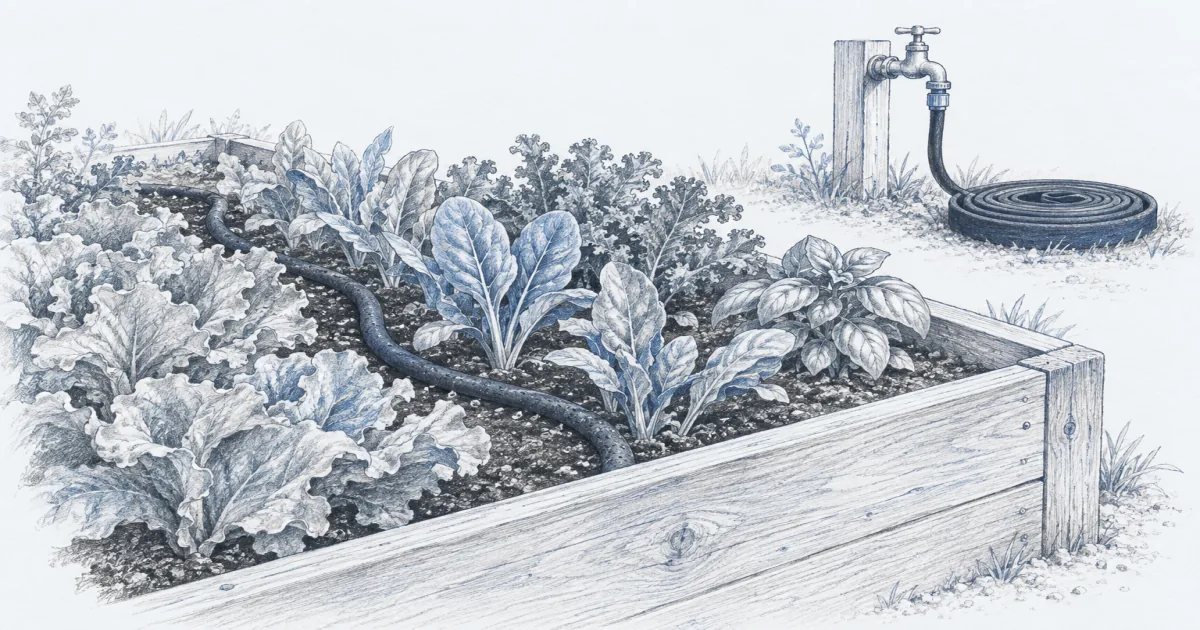
The Gilmour Round Soaker Hose is the best soaker hose for a garden bed. The 3/8-inch round profile curves easily around plants and along the edge of a raised bed, and the heavy-duty push-on couplings let you cut, shorten, or extend the hose and connect sections.
It works with any standard hose-end timer, and the drip is even along the full length. The 25-foot length is ideal for a raised bed or two, and you can link more for a bigger garden.
Who it is for: Raised beds, vegetable patches, and mixed borders with curves. Skip it if you need to cover a long straight row in one run, where a flat hose is easier.
Shop: Gilmour Round Soaker Hose on Amazon
Best for long rows: Hourleey flat soaker hose
The Hourleey Flat Soaker Hose 100 ft is the best soaker hose for long rows and big beds. You get two 50-foot sections that link end to end, so 100 feet of coverage, with metal stakes included to hold the hose flat.
The dual-layer PVC and nylon build resists kinks and UV, and the working range of 60 to 80 PSI suits most household spigots with a regulator. It saves up to 80 percent of the water a sprinkler would use, and it connects to a standard timer.
Who it is for: Vegetable rows, long borders, or a garden with several beds to cover at once. Skip it if you are watering one small bed and want the shortest possible run.
Shop: Hourleey Flat Soaker Hose on Amazon
Best long-lasting: Rocky Mountain Goods soaker hose
The Rocky Mountain Goods Soaker Hose is the heavy-duty pick. It is made from recycled rubber with reinforced quick-attach fittings, and it ships with an end cap so you can connect a second hose when you need more length.
The 50-foot, 5/8-inch hose saves up to 70 percent of the water a sprinkler uses, and the rubber build stands up to seasons of use. It is the hose to buy if you want to lay it in a bed and leave it.
Who it is for: Foundation plantings, shrub borders, and beds you want to leave on a timer all season. Skip it if your garden has tight corners where a flat hose would fit better.
Shop: Rocky Mountain Goods Soaker Hose on Amazon
Round versus flat: which soaker hose to buy
The shape decides where the hose works best, not the brand.
Round soaker hoses are more flexible, so they curve around plants and along irregular bed edges. They sit a little higher, which can make them harder to hide under mulch, but they bend without kinking. Choose round for raised beds, mixed borders, and anywhere the layout is not a straight line.
Flat soaker hoses lie low and run straight, so they are easy to hide between rows and less likely to trip you. They are the better choice for long vegetable rows and larger beds. The outer fabric needs a rinse before storage.
Many gardeners keep one of each. It is a small expense, and it means the hose always fits the bed.
Setting up a soaker hose so it lasts
A few small habits turn a soaker hose from a one-season item into a fixture.
- Add a pressure regulator. Set it to 10 to 25 PSI. This is the single best way to stop splits at the fittings.
- Keep runs under 100 feet. Pressure drops along the length, so the far end gets less water on a very long run.
- Rinse and store out of the sun. UV breaks down the material. Drain it and coil it in the garage for winter.
- Snake it 12 to 18 inches apart. For a dense bed, run the hose back and forth rather than one line down the middle.
- Mulch over it. An inch or two of mulch locks in moisture and hides the hose.
- Flush it occasionally. Open the end cap and run water through to clear grit and mineral build-up.
Common soaker hose mistakes
Most soaker hose problems trace back to the same few mistakes.
- Running full household pressure. The hose splits at the coupling, or the far end weeps unevenly.
- Watering too shallow and too often. Short daily runs keep roots at the surface. Soak deep and less often.
- Leaving it in the sun year round. UV makes the material brittle, and the fittings crack.
- Forgetting to flush it. Hard water clogs the pores, and the hose starts to water only near the spigot.
- Buying too short and daisy-chaining too much. Pressure drops with every added length.
Bottom line
The Gilmour Round Soaker Hose is the best soaker hose for a garden bed, because it curves around plants and drips evenly along its full length. The Hourleey Flat Soaker Hose 100 ft covers long rows, and the Rocky Mountain Goods rubber hose is the heavy-duty pick for beds you want to leave in place for years.
For the hand-watering side, see the best expandable garden hose and the best garden hose reel, and browse the garden and lawn care guides for the rest.
Frequently Asked Questions
What is better, a drip system or a soaker hose?
A soaker hose is simpler and cheaper, and it works well for a single bed or a few rows. A drip system with emitters is more precise and easier to expand to a whole garden, but it takes more parts and planning. If you are watering one or two beds, start with a soaker hose.
Are round or flat soaker hoses better?
Round hoses are more flexible, so they curve around plants and work well in raised beds and mixed borders. Flat hoses lie lower, resist rolling, and are easier to run straight down long rows. Many gardeners keep both: round for beds, flat for rows.
What are the downsides of a soaker hose?
They can clog over time, especially with hard water, and they water unevenly if the run is very long or the ground slopes. They also degrade in the sun if left out year round. Rinsing, storing them out of the sun, and keeping runs under about 100 feet all help.
Do I need a pressure regulator for a soaker hose?
It is the single best upgrade. Most soaker hoses are rated around 60 PSI, and household pressure can spike higher. A cheap inline regulator set to 10 to 25 PSI keeps the hose from splitting at the fittings and gives a more even soak.
How long should I run a soaker hose?
Long enough to wet the soil 6 to 8 inches deep, which is usually 30 to 60 minutes on a low-pressure setting. Push a trowel into the bed after a run and check. One or two deep soaks a week beat a short daily drizzle.
Can I bury a soaker hose?
You can cover it with mulch, and some gardeners bury flat hoses a few inches deep. Keep the hose below the mulch rather than under heavy soil, and mark the ends so you can find them. Round rubber hoses are better left on the surface under mulch.
Can I connect two soaker hoses together?
Yes, most have standard fittings and an end cap you remove to add another length. Keep the total under about 100 feet, because pressure drops along the run and the far end gets less water. If you need more, split the garden into zones.
Will a soaker hose work on a slope?
It will, but the bottom of the slope gets more water than the top. Run the hose across the slope rather than down it, use short cycles, and check the soil at both ends. A pressure regulator keeps the flow slow enough to soak in rather than run off.