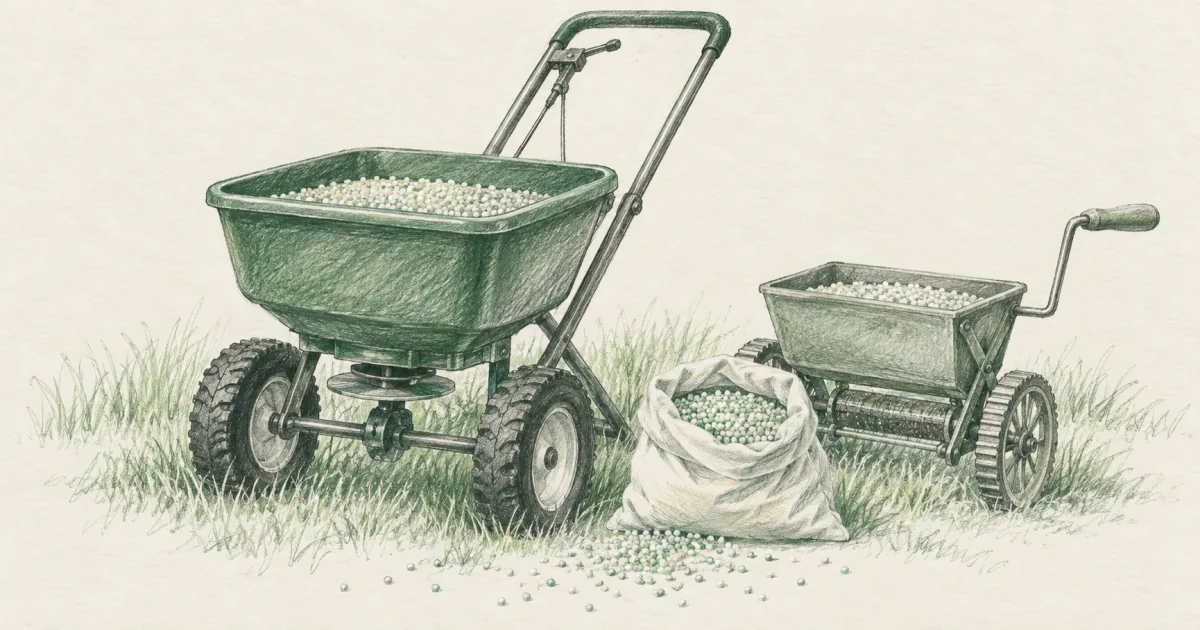
Best Lawn Fertilizer Spreader (2026): Broadcast and Handheld Picks
Garden and lawn care
The best lawn fertilizer spreader for most yards is the Scotts EdgeGuard DLX, with a 15,000 sq ft hopper and a lever that keeps fertilizer off the driveway. The VEVOR 60 lb walk-behind is the budget route, and the Scotts Whirl covers a small lawn by hand.
Our picks
The best lawn fertilizer spreader for most lawns is the Scotts EdgeGuard DLX when you want one tool that covers a suburban yard without stopping to refill. It arrives calibrated, so the first pass is the real thing rather than a test run. The VEVOR 60 lb walk-behind is the budget route for a large lawn, and the Scotts Whirl handles a small yard or a single bare patch.
This guide sits inside the garden and lawn care guides, alongside the best tiller for garden for bed prep and the best garden hose reel for watering the fertilizer in.
How much spreader you actually need
Match the spreader to the lawn before you look at price.
The hopper is the number that decides how pleasant the job is. A small hopper means you stop, squat, pour, and stand again, and most people under-fill it to avoid the weight. Buy a hopper that covers your lawn in one or two fills and the job turns into one steady walk.
Walk-behind models earn their space on an open lawn with long straight runs. If your lawn is broken up by beds, paths, and tight corners, a narrower spreader or a drop spreader is easier to steer and less likely to fling granules into the mulch.
Top pick: Scotts Turf Builder EdgeGuard DLX
The Scotts Turf Builder EdgeGuard DLX is the best lawn fertilizer spreader for most yards. The hopper holds enough Scotts product for 15,000 square feet, the frame arrives pre-calibrated, and the curved hopper and dual-bladed agitator keep granules funneling to the disc instead of bridging up in a corner.
The EdgeGuard lever slides to block the right side of the spread pattern, which is what lets you walk a sidewalk or driveway edge without throwing fertilizer onto concrete. Open it back up and you get the full broadcast width for the open lawn.
Who it is for: Yards from about 5,000 to 15,000 square feet, and anyone who wants one spreader for fertilizer, grass seed, and winter ice melt. Skip it if your lawn is mostly narrow strips and tight corners, where a drop spreader steers better.
Shop: Scotts Turf Builder EdgeGuard DLX on Amazon
Best value: VEVOR 60 lb walk-behind
The VEVOR Walk Behind Spreader is the best lawn fertilizer spreader value when the lawn is big and the budget is not. The 60 lb hopper cuts refills, the spread pattern reaches about 9.8 feet, and the 18 settings plus a disc pellet controller let you dial in fine grass seed or chunky fertilizer.
The eight-inch pneumatic tires are the quiet advantage here. They roll over grass, gravel, and packed snow, so the same spreader that seeds a lawn in April can put down ice melt in January. Assembly is tools-free, and the hopper lifts off for storage.
Who it is for: A large, open lawn on a budget, and anyone who wants a spreader that works in winter too. Skip it if you want the sturdier frame and the edge shutoff of the Scotts, which matter more on a smaller lawn with a lot of edges.
Shop: VEVOR walk-behind spreader on Amazon
Best handheld: Scotts Whirl
The Scotts Whirl Hand-Powered Spreader is the best lawn fertilizer spreader for a small yard, a bare patch, and the strip between the sidewalk and the curb. It holds enough product for 1,500 square feet, and it needs no cord, no battery, and no bench space.
You hold the trigger, crank clockwise, and walk at about four feet per second with the dial set to the number on the fertilizer bag. The adjustable arm support keeps the hopper steady against your side, and the whole thing rinses clean with a garden hose.
Who it is for: Small lawns, townhouse yards, spot seeding, and winter ice melt on a walkway. Skip it if your lawn is larger than about 1,500 square feet, where the refills stop being a fair trade for the low price.
Shop: Scotts Whirl hand spreader on Amazon
Broadcast or drop: which pattern fits
The two patterns solve different problems.
- Broadcast spreader: a spinning disc throws granules in a wide arc. It covers a lawn fast and overlaps well, which makes it the default for open turf. The tradeoff is that granules land beyond the edge of the lawn unless you shut off a side or leave a buffer.
- Drop spreader: product falls straight down in a band exactly as wide as the spreader. It is slow and it is the accurate one for narrow strips, beds, and tight turns.
If most of your lawn is open and only the edges are fussy, a broadcast spreader with an edge shutoff covers both jobs. If half your lawn is planting beds and a narrow side strip, a drop spreader will save you more time than it costs.
How to spread fertilizer without stripes
Stripes are almost always an application problem, so fix your technique before you blame the tool.
- Set the dial to half the recommended rate, then apply half the product walking north to south.
- Apply the other half walking east to west. The two crossing passes even out any light spots.
- Keep each pass about five feet from the last one and walk at a steady pace.
- Release the trigger on turns so you do not dump product in a pile.
- Water the lawn the day before, not the hour after, so granules do not sit on dry stressed grass.
Who should skip a walk-behind spreader
A walk-behind spreader is the wrong purchase in a few cases.
- Tiny lawns. Under about 1,500 square feet a hand spreader does the job in minutes and takes no floor space.
- Lawns cut up by beds and paths. A wide broadcast pattern puts product where you do not want it, and steering a big hopper through tight corners is slower than walking it by hand.
- Borrowing once a year. If you feed the lawn once each spring, borrow a neighbor's or buy the hand spreader.
- Sloped ground. Pushing a loaded hopper uphill is real work, and a light spreader with a smaller load is easier to control on a hill.
For everyone else, a push broadcast spreader is the tool that turns an hour of kneeling and pouring into one steady walk.
Bottom line
The Scotts Turf Builder EdgeGuard DLX is the best lawn fertilizer spreader for most yards, with a 15,000 sq ft hopper, an edge shutoff that keeps fertilizer off the driveway, and a frame that arrives ready to use. The VEVOR 60 lb walk-behind is the value pick for a large open lawn, and the Scotts Whirl is the one to buy for a small yard and a hand crank.
Once the feeding is done, the best garden hose reel keeps the hose off the grass, and the best tiller for garden handles the bed work. Browse the rest of the garden and lawn care guides for the full season.
Frequently Asked Questions
Is a rotary or drop spreader better?
Use a rotary, or broadcast, spreader for an open lawn because it throws product in a wide overlapping pattern and covers ground fast. Use a drop spreader when you have tight turns, narrow strips, or planting beds next to the grass, because it releases product straight down in a band you can aim. Many homeowners keep a broadcast spreader for the lawn and a drop spreader for the edges.
What is the best fertilizer spreader?
For most yards the Scotts Turf Builder EdgeGuard DLX is the best fertilizer spreader. It holds 15,000 square feet of product, comes calibrated, and the EdgeGuard lever closes off the right side of the spread pattern so you can run a driveway edge without sweeping fertilizer off the concrete. The VEVOR 60 lb walk-behind is the value pick for a big open lawn.
Is Scott's Elite spreader worth it?
The Scotts Elite is worth it if you have a very large lawn, since its wider pattern and 20,000 square foot hopper cut passes and refills. For a normal suburban lot the EdgeGuard DLX covers the same ground for less money, and the difference in finish comes down to your overlap and walking pace more than the spreader model.
What is the best spreader tool brand?
Scotts is the safest name to buy because every bag of Scotts product prints the dial setting for Scotts spreaders, so you skip the calibration guesswork. VEVOR and Agri-Fab are the usual picks when you want a plain walk-behind for less. If you use another brand of fertilizer, calibrate the spreader before your first pass.
How do I avoid stripes in my lawn?
Stripes almost always come from pace and overlap, not a broken spreader. Set the dial to half the recommended rate, apply half the product walking north to south, then apply the other half walking east to west. Keep each pass about five feet from the last one and walk at a steady pace.
Can I use a hand spreader for weed and feed?
Not usually. Weed control, crabgrass preventer, and combination weed-and-feed products need even coverage that a hand crank cannot meter, so most of those bags list settings for broadcast and drop spreaders only. Read the bag before you load a hand spreader. Seed, light fertilizer, and ice melt are fine.
How often should I fertilize my lawn?
Most cool-season lawns do well with three or four feedings a year, roughly early spring, late spring, early fall, and a late fall feeding before the grass goes dormant. Warm-season lawns want more of that feeding in late spring and summer. Water the lawn a day before you spread so the granules do not sit on dry, stressed grass.