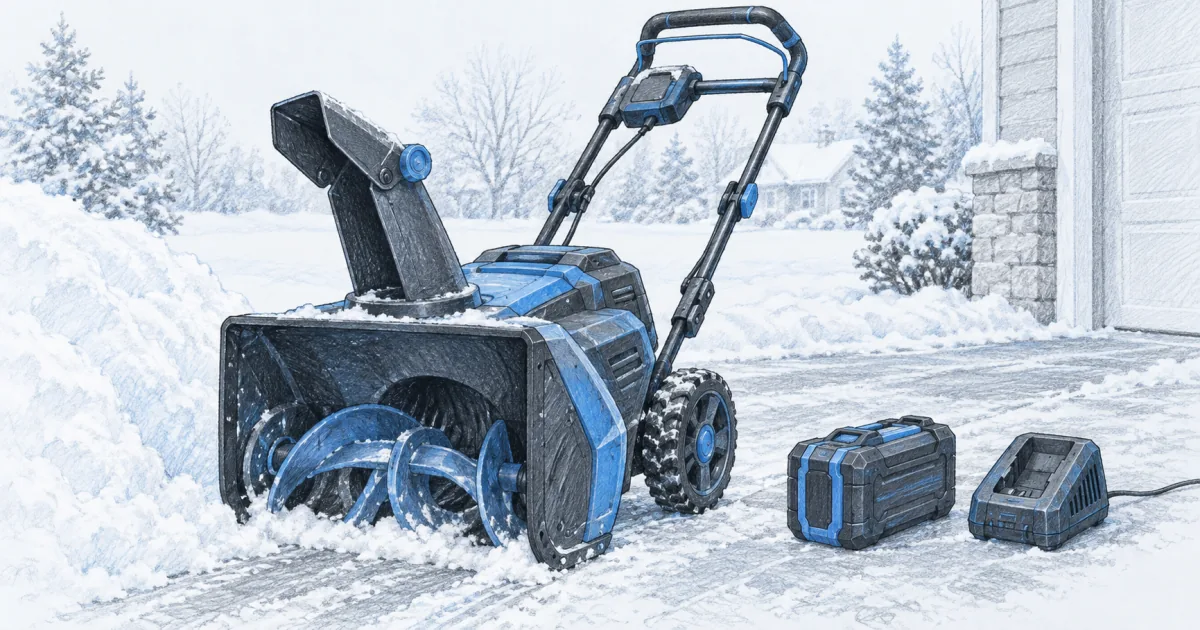
Best Battery Powered Snow Blower (2026): EGO and Greenworks Picks
Snow removal
The best battery powered snow blower for most driveways is the EGO SNT2125AP, an auger-propelled single-stage that pulls itself and cleans to the pavement. The EGO SNT2416 two-stage takes deep snow, and the Greenworks 40V is the budget pick.
Our picks
The best battery powered snow blower for most homeowners is the EGO Power+ SNT2125AP when your driveway is a normal two-car slab and you want one machine for four to ten inches of snow. The 24-inch SNT2416 two-stage takes deep drifts and long runs, and the Greenworks 40V is the budget pick for short drives. This guide sits inside the snow removal guides and pairs with the best cordless chainsaw for storm cleanup after the plow goes by.
Prices are US listing prices checked in October 2026.
Single-stage or two-stage: pick the lane first
The stage count matters more than the brand. A single-stage blower uses one auger to scoop snow and throw it up the chute. A two-stage adds a separate impeller that moves the snow out, which handles heavy and deep snow with fewer clogs.
Single-stage machines are lighter, cheaper, and easier to store. They work best on paved drives and snow up to about eight or ten inches. Two-stage machines are heavier and cost more, but they clear deep drifts, gravel, and the icy berm a plow leaves at the driveway mouth.
Then look at drive type. A push blower needs you to lean into it, an auger-propelled model pulls itself on the auger, and a self-propelled two-stage has its own drive wheels. On a long driveway, the powered drive is the feature you will feel most.
What size driveway can a single-stage blower clear?
A 21-inch single-stage clears a two-car driveway of four to ten inches on one charge. Expect about 35 to 45 minutes in light snow and 20 to 30 minutes in wet snow from two 7.5Ah packs. A 100 ft by 20 ft drive is about 2,000 square feet, which works out to about 1,140 linear feet of walking to clear it.
When do you need a two-stage machine?
Go two-stage when your driveway runs past about 60 feet, your snow is routinely wet and deep, or a plow leaves a hard berm at the mouth. A 24-inch two-stage throws up to 50 feet and clears a 24-car driveway of eight-inch snow per charge. At 198 pounds it also needs real floor space.
How many tons of snow does your driveway hold?
An 8-inch storm on a 3,200 square foot driveway is about 6.6 tons of average snow, and about 13 tons if the snow is wet. Snow runs roughly 10 inches to 1 inch of water, and wet snow is closer to 5 to 1, so the same depth can weigh twice as much.
That weight is why run time is not a fixed number. The machine is not fighting inches, it is fighting tons, at a rate that changes with water content. It also explains why two neighbors with the same blower report very different run times.
Why does wet snow drain the pack so fast?
Because the same depth of wet snow is twice the weight, and the auger still has to lift it out of the housing and up the chute. A 5-to-1 snow holds twice the water of a 10-to-1 snow, so the machine is pushing double the mass through the same opening, and it slows to a crawl in slush where powder disappears.
Does the tonnage change which machine you need?
Yes, on the long lane. A 2,000 square foot run of wet snow is over 8 tons, which is the point where a single-stage pack gives out before the job does and a two-stage with two 10.0Ah packs is the right tool.
How much does a battery snow blower cost to run?
A few dollars a winter. Two 56V 7.5Ah packs hold about 840 watt-hours, so a full charge costs about 14 cents at the average US electricity price of about 17 cents per kilowatt-hour. The 24-inch two-stage runs two 10.0Ah packs, about 1,120 watt-hours and about 19 cents a charge. A gas single-stage burns about 0.4 to 0.5 gallons an hour, about $1.40 to $1.75 an hour at $3.50 a gallon.
What does a charge actually cost?
A 20-storm winter at about 14 cents a charge is about $2.86 of electricity. Ten hours of gas blower time runs about $14 to $17 at the same rates, so the battery machine costs roughly a fifth as much to feed.
What does it cost to clear 1,000 square feet?
About 4 cents a clearing on the two-stage, about 4.4 cents on the single-stage, and about 14 cents on the little Greenworks, because a small drive uses most of one charge. A 16-car driveway is roughly 3,200 square feet and a 24-car drive about 4,800.
The two-stage's bigger packs pay for themselves here. It holds more watt-hours and clears half again as much driveway, so the cost per square foot stays at about 4 cents even though the pack is larger.
Battery or gas, per hour of clearing?
At about 40 minutes of runtime, the EGO packs cost about 21 cents an hour to run. A gas single-stage of the same class costs about $1.40 to $1.75 an hour, so the battery machine runs for roughly one-eighth the fuel cost. The trade is runtime: a gas machine refills in 90 seconds, while a battery needs a swap or a charge.
Top pick: EGO Power+ SNT2125AP
The EGO Power+ SNT2125AP is the best battery powered snow blower for most driveways. It clears a 21-inch path, throws snow up to 45 feet, and runs on two 56V batteries that work together for peak power.
The auger-propelled design uses the steel auger to pull the machine forward, so you steer more than you push. Heated grips and two LED headlights cover cold, dark mornings. EGO rates it to clear a 16-car driveway of 8-inch snow on the two included 7.5Ah packs, and a full charge on that pair takes under 30 minutes. It runs on any EGO 56V ARC battery you already own.
Who it is for: Homeowners with a paved two-car driveway and typical four to ten inch storms. Skip it if your lane is long and rural or your snow is often deep and wet, because the two-stage below is the better tool.
Shop: EGO SNT2125AP on Amazon
Best for deep snow: EGO SNT2416 two-stage
The EGO Power+ SNT2416 is the best battery powered snow blower for deep snow and long driveways. The two-stage design pairs a variable-speed steel auger with an impeller, so heavy, wet snow moves through the chute instead of clogging it.
The machine is self-propelled with trigger-controlled steering and a 200-degree remote chute, and it rides on large wheels that grip a sloped or gravel lane. Its intake is 20 inches tall, which is what lets it take a drift in one bite instead of shaving it down.
EGO rates it to clear up to a 24-car driveway of 8-inch snow per charge on its two 10.0Ah packs, and it throws snow up to 50 feet. Heated grips cover early starts, and the batteries are shared with the rest of the EGO 56V line.
Who it is for: Homeowners with a long or steep driveway, frequent deep snow, or a climate that dumps wet, heavy storms. Skip it if you have a short, flat drive and limited storage, because the single-stage picks are easier to live with.
Shop: EGO SNT2416 on Amazon
Best budget: Greenworks 40V 20-inch
The Greenworks 40V 20-inch is the best battery powered snow blower for a tight budget and a short drive. It clears a 20-inch path, runs on one 40V battery, and weighs far less than a two-stage machine.
The brushless motor starts with a button and holds power as the pack drains. A 180-degree chute sends snow where you want it, and the machine folds down for shelf storage. Because it runs on the Greenworks 40V platform, the same battery powers a 40V mower, trimmer, or blower if you own them. It is a good fit for a one-car drive, a sidewalk, and a patio.
Who it is for: Homeowners with a short driveway and light, dry snow, or anyone already on the Greenworks 40V platform. Skip it if your drive is long or your snow is often deeper than eight inches, because you will want a two-stage.
Shop: Greenworks 40V 20-inch on Amazon
Runtime, batteries, and cold-weather habits
Amp-hours set your run time, and cold cuts into it. A single-stage blower on two 7.5Ah packs runs about 35 to 45 minutes in light snow and 20 to 30 minutes in wet snow. Expect 10 to 20 percent less in single-digit temperatures.
Keep the packs indoors until you head out, then load them warm. Cold saps a lithium pack before you start, and a warm pack holds voltage longer under load. If you own other tools on the same platform, rotate those packs into the blower so you always have a charged pair.
Match the auger and drive speeds to the snow. Running the auger at half speed in powder stretches the charge, and slowing it down is what gets a two-stage through a long, light fall on one set of packs. Save the top speed for the plow berm at the end of the drive.
Never store a battery blower with snow packed around the auger. Ice can lock the auger and trip the machine's safety circuit, so clear the housing after each use and store the machine under cover.
What actually stops a snow blower?
Not depth, usually. A blower gives up on surface, slush, or a frozen auger long before it runs out of snow to move. Knowing which one you have is the difference between a swap and a repair.
The single-stage machines are the ones that stop on rough ground. Their small wheels catch on a heaved joint or a curb lip and the machine stalls, which is a surface problem, not a power problem. A two-stage rides on bigger wheels and clears the same drive.
Why does a single-stage stall on a cracked driveway?
Because the auger is also the drive. When the housing rides up on a high spot, the auger loses its grip on the pavement and the machine has nothing to pull with. It feels like the blower catching and stopping suddenly, which is exactly what is happening.
What do you do about an auger that freezes?
Thaw it, dry it, and change one habit. Ice forms in the housing when snow is left packed after a session, so clear the auger and chute at the end of every use and store the machine under cover. A blower that freezes twice in a row is usually one stored outside between storms.
Who should still buy a gas snow blower
Battery blowers cover most suburban drives. Choose gas if any of these fit:
- Your driveway is very long or rural. A gas two-stage runs all day on one tank and needs no battery swaps.
- You get heavy lake-effect or mountain snow. Gas machines push deeper, denser snow without slowing for a charge.
- You clear for a living or for several properties. Endless run time and easy refueling matter more than quiet operation.
- You already own gas tools and a fuel routine. If a can of gas and an oil change are second nature, a gas blower is familiar.
For a normal two-car driveway, a battery blower starts easier, runs quieter, and stores without a fuel can, which is why most homeowners are better served by the picks above.
How do you match a battery blower to your driveway?
Size the machine to the run you actually clear. The number that decides your charge is the walking distance, which is the length times the number of passes across the width.
How many linear feet do you actually walk?
A 20-foot-wide driveway needs about eleven overlapping passes across, so a 100-foot run is roughly 1,140 linear feet of walking. That walk, not the snowfall number, is what drains the packs.
How does a two-car driveway compare with a long lane?
A two-car driveway of about 400 square feet is a single-stage job on one charge. A lane that runs past about 60 feet, or a wet, heavy storm, is where the two-stage machine and its second pair of packs pay off.
When is the drive too long for one charge?
When you would need more than one pair of packs to finish, step up a class or plan a swap. The EGO single-stage clears a 16-car drive of 8-inch snow on one pair, and the 24-inch two-stage clears up to a 24-car drive per charge.
Bottom line
The EGO Power+ SNT2125AP is the best battery powered snow blower for most driveways, with a 21-inch auger-propelled deck, heated grips, and 45-foot throw on two 56V packs. The EGO SNT2416 two-stage is the pick for long lanes and deep, wet snow, and the Greenworks 40V 20-inch is the budget choice for a short drive and a sidewalk. All three start with a button and skip the fuel can.
For the rest of the winter gear, browse the snow removal guides, the best cordless chainsaw for storm cleanup, the best log splitter for home use for firewood season, and the best electric wood chipper for home use for the branches the storms bring down.
Frequently Asked Questions
Are battery snowblowers worth it?
Yes, for most suburban driveways. A modern brushless battery blower starts with a button, throws snow 25 to 50 feet, and needs no oil changes, fuel cans, or carburetor work. It is not the right tool for a rural lane in a heavy-snow climate, where a gas two-stage still lasts longer on a big storm. For four to twelve inches on a normal drive, battery is now the easier machine to own.
What is the best battery-powered snow blower according to Consumer Reports?
Consumer Reports and other independent testers have ranked EGO's 56V two-stage models near the top of their battery snow blower tests in recent years. The EGO SNT2416 is the two-stage model most buyers land on, and the SNT2125AP is the better first blower for a normal two-car driveway. Always check the latest test year, because the rankings shift as new models ship.
What is the best battery operated blower on the market?
For a normal driveway, the EGO Power+ SNT2125AP is the best all-round battery snow blower. It clears a 21-inch path, pulls itself forward with the auger, and handles most storms on the two included 7.5Ah packs. If you face deep drifts or a long lane, the EGO SNT2416 two-stage is the stronger machine.
Is EGO or Ryobi snow blower better?
They aim at different buyers. EGO's 56V platform has more power per tool and offers a true two-stage option, which matters in heavy snow. Ryobi's 40V line is cheaper to enter and shares batteries with a huge range of home tools, but it focuses on lighter single-stage blowers. If deep snow is common, choose EGO. If you want the lowest entry price and already own Ryobi 40V batteries, Ryobi is the practical pick.
How long does a battery snow blower last on a charge?
Expect 20 to 45 minutes of run time depending on snow and machine. Two 7.5Ah EGO packs run about 35 to 45 minutes in light snow and 20 to 30 minutes in wet snow. Cold cuts capacity by 10 to 20 percent, so store the packs indoors and load them warm.
Do battery snow blowers work in wet snow?
They work, but they slow down and use more energy. Heavy, wet snow takes a slower pace and a second pass on a single-stage machine. A two-stage blower handles wet snow better because the impeller moves it through the chute instead of relying on the auger alone.
Can a battery snow blower clear a long driveway?
Yes, if you match the machine to the run. A single-stage EGO clears a 16-car driveway of 8-inch snow on one charge, and the 24-inch SNT2416 covers up to a 24-car drive. Beyond that, plan a battery swap or step up to gas.
Do I need two batteries for a snow blower?
Most EGO blowers ship with two packs and use them together, and that is the setup you want. Two packs let the machine draw peak power, and when one pair drains you can swap in a charged pair instead of waiting. If you already own EGO 56V tools, those packs work in the blower too.
How many tons of snow is on a driveway after an 8-inch storm?
About 6.6 tons on a 3,200 square foot driveway of average snow, and about 13 tons if the snow is wet. Snow runs roughly 10 inches to 1 inch of water, and wet snow is nearer 5 to 1, which is why the same depth can weigh twice as much and drain a pack twice as fast.