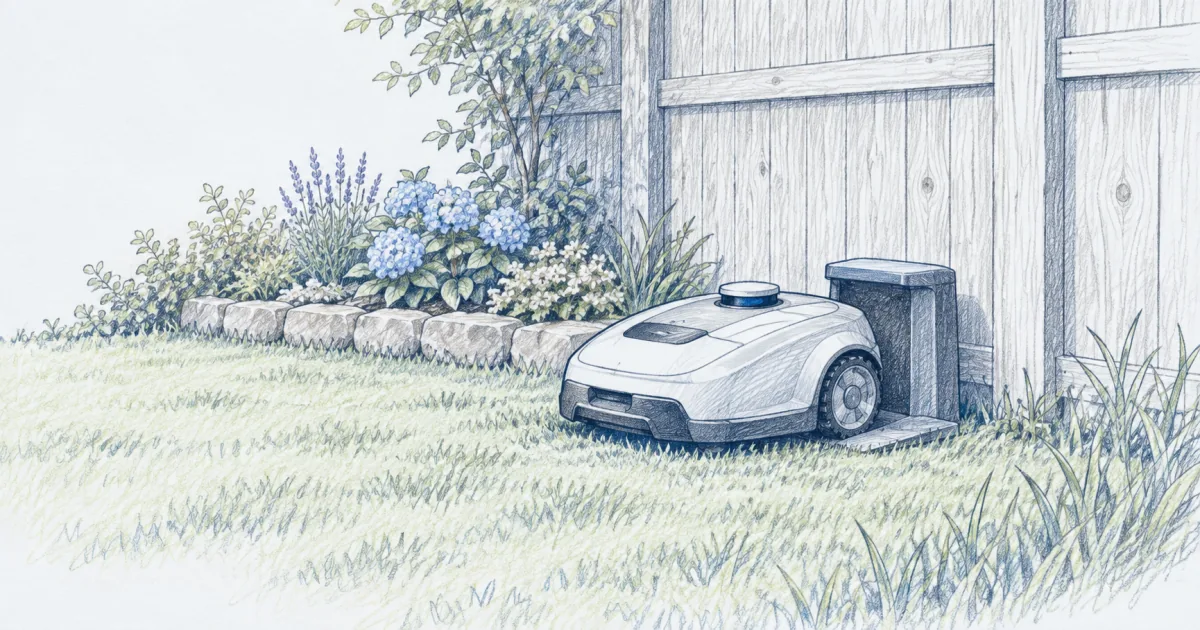
Best Robot Mower for Small Yard (2026): Wire-Free Picks
Lawn mowers
The best robot mower for a small yard is the ECOVACS Goat O1000 RTK, which maps a quarter acre with no boundary wire and cuts close to beds. The NovorikX X3 is the best at steering around toys and pets, the Sunseeker S4 is the pick under heavy shade, and the ANTHBOT M5 is the value route for an eighth-acre lot.
Our picks
The best robot mower for a small yard is the ECOVACS Goat O1000 RTK when you want the lawn handled on a schedule without trenching a wire. It earns the pick on setup and on edge behavior: about five minutes of app mapping, then zones, no-go areas, and cutting height all live on your phone.
This guide sits in the lawn mower guides next to the best electric lawn mower for a small yard for lots under a quarter acre and the best riding lawn mower for 1 acre for the bigger property next door.
What a robot mower actually does for a small yard
A robot mower is not a faster lawn mower. It is a mower you stop thinking about. You set a schedule, it leaves the dock on its own, mows in stripes or a grid, and returns to charge. For a small yard the appeal is not speed. It is that the lawn gets cut twice a week instead of once, and short clippings do the fertilizing.
Two things decide whether a robot works for your lot.
- Navigation. RTK uses a fixed reference station and satellite correction. LiDAR and camera systems map the yard itself. RTK is precise and simple once the antenna is placed. LiDAR is the safer bet under a heavy canopy.
- Edge behavior. No robot mower trims perfectly flush to a wall. The good ones cut within a few inches, and you clean up the last strip with a string trimmer.
The sweet spot for a small yard is a mower rated for a quarter acre or less. A bigger mower works too, but you pay for battery and cutting width you will not use.
Top pick: ECOVACS Goat O1000 RTK
The ECOVACS Goat O1000 RTK is the best robot mower for most small yards. It uses RTK positioning with camera and 3D-ToF sensors, so it holds a precise line rather than wandering, and it covers up to about a quarter acre.
Setup is the part that sells it. There is no boundary wire to bury and no base station to calibrate. The mower maps the yard on a first drive, then you split the map into zones and no-go areas in the app. It squeezes through gaps as narrow as about 2.3 ft, which matters if your beds and fence leave a tight path between the front and back lawn.
Obstacle handling is good enough to leave it alone. AIVI 3D detection reads furniture, toys, and pets and routes around them, and the mower handles slopes up to about 45% with an IPX6 rating for wet grass.
Who it is for: A quarter acre or less, mixed beds and lawn, and anyone who wants the whole thing to run from a phone. Skip it if the only spot you have for the reference station is under an eave.
Shop: ECOVACS Goat O1000 RTK on Amazon
Best obstacle handling: NovorikX X3
The NovorikX X3 is the pick when the yard has more in it than grass. RTK positioning holds the mowing line, while dual front-facing cameras add AI obstacle recognition rated for more than 200 objects, so the mower reads a stray ball, a pet, or a garden chair and steers around it.
It is built for lawns up to about a quarter acre, the same class as the top pick, and it handles slopes up to 35%. The zero-edge setting cuts closer to beds than most robots, which trims the string-trimmer cleanup. It also runs at 58 dB, so early-morning and evening schedules will not bother the neighbors, and an IPX6 rating plus a rain sensor sends it home when the weather turns.
The tradeoffs are real. The first mapping session is fiddlier than the app-first picks here, and the brand is newer, so there is less long-term ownership history to lean on than ECOVACS or Sunseeker.
Who it is for: A quarter-acre yard with kids' toys, pets, or patio furniture that moves around. Skip it if you want the simplest possible first-setup.
Shop: NovorikX X3 on Amazon
Best in heavy shade: Sunseeker S4
The Sunseeker S4 is the best robot mower for a shaded, tree-heavy yard. It builds its map from a 3D LiDAR sensor that scans 360 degrees with a 70 degree vertical range, backed by vision AI through a 10 TOPS chip, so it navigates by what is in front of it rather than by satellite alone.
That combination is what lets it cover a yard up to about a quarter acre under dense canopy and along tall structures. It maps in a single pass, saves multiple maps for separate front and back lawns, and supports a long list of zones and no-go areas for beds and play areas.
It is also the most terrain-capable of the three. Rear-wheel drive and off-road wheels push it up slopes around 22 degrees, and it rolls over obstacles about 3.5 cm tall instead of treating every root as a wall.
Who it is for: Yards with mature trees, deep shade, or narrow garden paths between beds. Skip it if your budget tops out near $700, because there is a cheaper way to do this.
Shop: Sunseeker S4 on Amazon
Best value: ANTHBOT M5
The ANTHBOT M5 is the value pick for a small lot, and it is the one to buy if your yard is an eighth of an acre or so. The body is compact enough to reach corners and footpaths bigger mowers miss, and it drives a 20 cm five-blade disc that leaves a clean cut.
Navigation is full-band RTK plus dual vision cameras, and ANTHBOT rates it for cutting about 150 sq m per hour in a U-shaped path. You can set the cutting height from the app in small steps between about 1.2 in and 2.8 in, and the mower handles slopes up to roughly 45%.
The kit is the part that makes it a deal. It ships with the mower, a garage shelter, a charging dock, a blade set, and the RTK reference station, so you are not buying mounts and blades on top of the mower. Built-in 4G adds anti-theft tracking.
Who it is for: An eighth-acre lawn, a tight layout, or a first robot mower. Skip it if your grass area is closer to a quarter acre, where you will want the extra coverage of the Goat.
Shop: ANTHBOT M5 on Amazon
Wire-free or boundary wire: which fits your yard
Every pick here is wire-free, and that is now the right default for a small yard. The old knock on wire-free mowers was mapping accuracy, and the current RTK and LiDAR systems closed most of that gap.
If you rent, or you change beds and paths every couple of seasons, wire-free is the obvious choice. If you want to avoid an antenna altogether, the LiDAR Sunseeker S4 has no reference station to place.
What a robot mower still will not do
A robot mower mows often and quietly, and it still leaves you a few jobs. Set expectations before you spend $700 or more.
- It will not edge perfectly. Firm, flat edges along a driveway are the hardest thing for a robot. Keep a trimmer for the last two inches.
- It will not clear leaves or sticks. A lawn with heavy leaf drop or fallen branches still wants a blower and a rake.
- It will not mow a jungle. If the grass is tall and wet, mow it down first, then let the robot keep it short.
- It will not handle a steep bank. Check the slope rating against the worst hill on your lot.
- It needs a path home. Obstacle avoidance helps, but a yard that changes every day still benefits from a few no-go zones.
Bottom line
The best robot mower for a small yard is the ECOVACS Goat O1000 RTK, because it maps a quarter acre without a wire, cuts close to beds, and runs the whole schedule from an app. The NovorikX X3 is the pick for a cluttered yard, since it steers around toys and pets and cuts a clean zero edge. The Sunseeker S4 is the pick for heavy shade and tree roots, and the ANTHBOT M5 is the value route for an eighth-acre lot with a tight layout.
If you are still deciding whether a robot makes sense at all, the best electric lawn mower for a small yard covers the push-mower route for the same size lot, and the best riding lawn mower for 1 acre covers what you need when the property is bigger. Browse the lawn mower guides for the rest.
Frequently Asked Questions
What is the best robot mower for a small yard?
For most small yards the ECOVACS Goat O1000 RTK is the best robot mower. It maps a quarter acre from the app with no boundary wire, cuts within about an inch of beds, and steers around toys and pets with its camera and 3D sensors. A quarter-acre lot is the top of its range, so it finishes a small lawn well inside a day.
Do robot mowers work in shade?
Some do, and the ones that do not rely on satellite signals alone. The Sunseeker S4 uses 3D LiDAR, which reads the yard itself rather than the sky, so it keeps its map under a dense tree canopy. RTK mowers like the Goat O1000 and the ANTHBOT M5 can also work in shade as long as the reference station has a clear view of the sky.
Which robot mower is best for a very small lawn?
The ANTHBOT M5 is the best fit for a lawn around an eighth of an acre. Its body is small enough to fit through gaps and along narrow footpaths where bigger mowers get stuck, and the kit includes a garage for the dock. Just plan on a recharge cycle if your grass area runs closer to a quarter acre.
Which robot mower avoids obstacles best?
The NovorikX X3 leans hardest on obstacle recognition. Its dual front cameras are rated to read more than 200 objects, so it steers around toys, pets, and garden furniture while RTK keeps the mowing line, and it runs at a quiet 58 dB. The ECOVACS Goat O1000 uses AIVI 3D detection for the same job, so either handles a cluttered yard.
Do I still need to edge with a robot mower?
Usually a little. Even mowers with edge-cutting modes leave some grass in the tightest corners, against walls, and around posts. The practical routine is to let the robot handle the open lawn and touch up the fence line and bed edges with a string trimmer every couple of weeks.
How long does a robot mower take to set up?
Setup is shorter than most people expect. The ECOVACS Goat O1000 maps itself in about five minutes of app time, and the ANTHBOT M5 advertises a ten-minute RTK setup. The Sunseeker S4 spends its first pass building a 3D map. The one step that takes planning is placing the RTK station where it can see the sky.
Can a robot mower handle a sloped small yard?
Yes, within limits. The Goat O1000 is rated for slopes up to 45 percent, roughly 24 degrees, and the Sunseeker S4 handles about 42 percent with rear-wheel drive. A small yard with a steep bank is still easier with a robot than a push mower, but check your worst slope against the rating before you buy.
How much should I expect to spend on a robot mower for a small yard?
A wire-free mower sized for a small lot generally runs from about $650 to $1,000. The ANTHBOT M5 and the ECOVACS Goat O1000 sit at the lower end of that range, and the Sunseeker S4 sits at the top. You are paying mostly for navigation, coverage, and how well the mower reads the edge of a bed.
Do robot mowers need Wi-Fi?
They need a connection for the app features you will use most: mapping, schedules, zones, and no-go areas. The mowers themselves can start from their own control panel if the network drops, but you lose the map editing and schedule changes until it reconnects. A mesh point near the yard helps on a lot where the router is far from the back door.