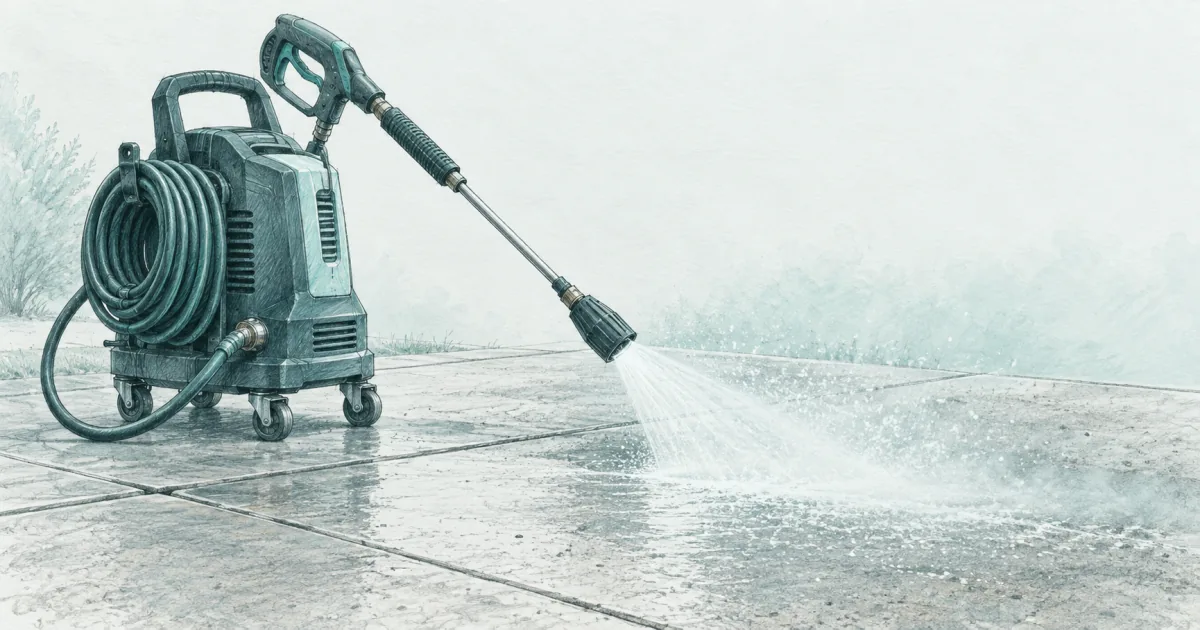
Best Pressure Washer for a Driveway (2026): PSI and Picks That Work
Pressure washers
The best pressure washer for a driveway balances PSI, water flow, and how far you have to drag it. The Westinghouse ePX3500 leads for most concrete, with a 3,000 PSI model for heavy stains and a compact pick for small slabs.
Our picks
The best pressure washer for a driveway is the Westinghouse ePX3500 when you want 2,500 PSI in a package one person can handle. The WPX3000e brings 3,000 PSI for stained concrete, and the ePX3100v keeps the price low for shorter slabs. This guide sits inside the pressure washer guides.
Prices are US listing prices checked in October 2026.
What PSI a concrete driveway actually needs
PSI is the force of the water, and GPM is how much water comes out. For a driveway, both matter. Pressure breaks the bond between grime and concrete, and flow carries the dirt away.
Two cautions. First, the "max PSI" on the box is a peak number, and the rated PSI is what you actually get at the nozzle during steady work. Second, more pressure is not always better. The 0-degree tip concentrates the stream enough to etch soft concrete, so most of the driveway should be cleaned with a 25-degree tip or a turbo nozzle.
What is the difference between max PSI and rated PSI?
Max PSI is a peak number the pump can hit briefly, and rated PSI is what the nozzle sees during steady work. The ePX3500 lists 2,500 max and 2,000 rated. Shop by rated PSI, because that is the pressure actually cleaning your concrete.
Which nozzle should you start with on concrete?
Start with a 25-degree tip for the whole slab, then switch to a turbo nozzle for tire marks and embedded dirt. Save the 15-degree tip for edges, and treat the 0-degree tip as a spot tool you never hold still on concrete.
How far should you hold the wand from concrete?
Hold the wand about 12 to 18 inches off the slab and keep it moving. Closer than that concentrates the stream enough to etch soft concrete, and farther than about two feet just spreads the water without cleaning. A 25-degree tip at a foot or so is the safe default.
How long does a driveway take to clean?
A two-car driveway is about 400 to 600 square feet and takes roughly 25 to 40 minutes with a turbo nozzle, or longer in two passes on heavy stains. At 1.76 GPM, a 30-minute wash uses about 53 gallons of water.
What are cleaning units, and why do they beat PSI alone?
Cleaning units are max PSI multiplied by max GPM, and they are the honest way to compare two machines that both list 1.76 GPM. The ePX3500 scores 4,400 and the WPX3000e scores 5,280, so the bigger washer moves about 20% more work per minute even before you change a nozzle.
That number explains why the WPX3000e handles patios, siding, and walkways and still lifts the dirt a 2,500 PSI machine leaves behind. On concrete the difference shows up as passes, not as a different finish.
Why does the 3,000 PSI machine clean faster if the GPM is the same?
Because pressure is what breaks the bond between grime and concrete, and flow is what carries it away. At equal flow, the machine with more rated pressure cleans stubborn dirt faster. At equal pressure, the machine with more flow moves more dirty water off the slab, which is why a 2,500 PSI unit at 2.2 GPM can beat the ePX3500 on a big flat driveway.
Does more cleaning power risk the concrete?
Yes, past a point. Around 3,000 PSI with a 25-degree tip is safe on cured concrete when you keep the wand moving. The risk comes from the 0-degree tip held in one spot, which will etch or pit a soft, young slab regardless of the machine's rating.
Top pick: Westinghouse ePX3500
The Westinghouse ePX3500 is the best pressure washer for a driveway for most homeowners. It delivers 2,500 max PSI and 1.76 max GPM with a turbo nozzle that lifts tire marks and embedded dirt, all from a 19-pound frame that stores on a shelf and sells for about $169.
The four quick-lock wheels steer a full 360 degrees, and the low center of gravity keeps the unit from tipping when you pull the hose. The 25-foot hose and 35-foot cord reach most of a two-car driveway from a single outlet. A 20-ounce onboard soap tank handles pre-treatment, and the Total Stop System shuts the pump off when you release the trigger.
Who it is for: Homeowners with a normal concrete or paver driveway who want one compact washer for the driveway, patio, siding, and car. Skip it if your slab has years of set-in oil stains, because the 3,000 PSI pick below clears those faster.
Shop: Westinghouse ePX3500 on Amazon
Best for heavy stains: Westinghouse WPX3000e
The Westinghouse WPX3000e is the best pressure washer for driveways with real staining. It runs 3,000 max PSI and 2,600 rated PSI, which is enough to pull old leaf tannin, mildew, and tire marks out of concrete in fewer passes than a 2,000 PSI unit.
The steel frame and 10-inch wheels make it stable on rough ground, and the 35-foot GFCI cord gives you room to work. The half-gallon soap tank holds enough detergent for a full driveway, and the five nozzles cover everything from a gentle rinse to a focused turbo blast. The M22 fittings accept a surface cleaner and a foam cannon, so you can add those later without a new machine. It lists at about $279.
Who it is for: Homeowners with stained, weathered, or large concrete who want gas-level cleaning without gas. Skip it if you have a small clean slab, because the ePX3500 does that job for less.
Shop: Westinghouse WPX3000e on Amazon
Best budget: Westinghouse ePX3100v
The Westinghouse ePX3100v is the best pressure washer for a small driveway on a budget. It delivers 2,100 max PSI and 1.76 max GPM, which is plenty for light concrete, a walkway, a patio, and a fence, and it does it from a package that weighs just over 17 pounds.
The built-in handle and compact body make it easy to lift into a trunk or onto a shelf. It comes with three nozzles (15-degree, 25-degree, and turbo), a detachable foam cannon for pre-treating, and a 20-foot hose. The Total Stop System protects the pump between passes. It is the cheapest of the three at about $129.
Who it is for: Renters and homeowners with a short driveway or a mix of small hard surfaces, plus anyone who wants the lowest price of the three. Skip it if your concrete is heavily stained, because you will want the extra pressure of the WPX3000e.
Shop: Westinghouse ePX3100v on Amazon
What does a driveway wash cost in water and electricity?
A driveway wash costs on the order of 50 cents in water and power, so the machine, not the utilities, is the real spend. The savings over hiring the job out are what justify buying one.
How much water does a driveway wash use?
At the ePX3500's 1.2 rated GPM, a 30-minute pass uses about 36 gallons. Open it to the 1.76 max GPM and the same pass uses about 53 gallons. At a rough US municipal rate near a penny a gallon, that is about 36 to 53 cents of water.
How much electricity does an electric washer use?
A 13-amp 120-volt washer draws about 1,560 watts. Thirty minutes at that draw is 0.78 kWh, or about 13 cents at the US average of about 17 cents per kWh. Water and power together come in under a dollar for a two-car slab.
What does one wash cost per 1,000 square feet?
About 82 cents per 1,000 square feet on a two-car slab, counting water and power: one 30-minute pass is about 36 gallons and 0.78 kWh, so a full driveway costs under a dollar and the machine is the real spend.
Is a surface cleaner worth buying?
For a driveway you clean twice a year, a surface cleaner pays for itself in time. It cleans a wide circle at once instead of leaving stripes, and it cuts a two-car slab from 25 to 40 minutes down to a steady sweep. The WPX3000e takes one on its M22 fitting; the ePX3500 takes common 1/4-inch accessories.
Nozzles, technique, and the surface cleaner question
The nozzle does as much work as the machine. Match it to the surface and keep the wand at about 45 degrees.
- 25-degree tip is your default for concrete. It cleans a full driveway without etching the surface.
- Turbo nozzle spins a tight stream and clears tire marks and embedded dirt fastest.
- 15-degree tip is for edge work and stubborn spots after a turbo pass.
- Soap tip or foam cannon lays down detergent so the pressure has less work to do.
- 0-degree tip is for tough spots only. Never hold it in one place on concrete.
Work in overlapping passes, start at the top of any slope, and pre-treat oil or rust with detergent before you blast. A surface cleaner is the fastest way to cover a whole driveway because it cleans a wide circle at once and avoids the stripes a wand leaves behind. It connects to the WPX3000e with an M22 fitting, and the ePX3500 takes common 1/4-inch accessories.
Which driveway stains come out with pressure, and which need a chemical?
Pressure lifts loose dirt, pollen, and mildew film. It does not lift rust, tannin, or cured oil on its own, no matter what the PSI number says. Those need a chemical and a few minutes of dwell time before the wand goes anywhere near them.
The order matters more than the product. Wet the slab, apply the chemical, wait, then wash. A detergent that sits for five minutes does more than a stronger machine applied to a dry stain for one second.
Why does the wand alone fail on set-in stains?
Because the stain is in the pores, not on the surface. The WPX3000e clears patios, siding, and walkways, and it still walks past set-in concrete stains, which is the job a surface cleaner does once rather than twenty minutes of pressure in one spot.
How much detergent does a full driveway use?
The ePX3500 carries a 20-ounce onboard tank and the WPX3000e a half-gallon tank. At a typical dilution one tank treats a two-car slab once, so buy detergent by the season rather than assuming the tank covers more than one wash.
What cord does an electric pressure washer need?
These machines draw about 13 amps at 120 volts, which is 1,560 watts. Use a 14-gauge extension cord up to about 25 feet, and step up to 12-gauge for a longer run, because a thin cord on a long run drops voltage and trips the breaker halfway through a pass.
Does the cord change the pressure?
It can. A long, thin cord starves the motor, and the pump loses speed, which shows up as a weaker stream at the wand. If the machine feels flat on a 50-foot cord, try a shorter one before you blame the washer.
Can two of these run on one circuit?
No. Two 13-amp machines on a shared 15-amp circuit will trip it. Run one at a time, and if the outlet is on the same circuit as a garage fridge or a freezer, expect to reset the breaker.
Who should buy a gas pressure washer instead
An electric washer covers most driveways. Choose gas if any of these fit:
- You clean professionally. Gas units run all day and reach 3,500 to 4,000 PSI.
- Your driveway is unusually large. More PSI and GPM means a big slab takes far less time.
- You are far from an outlet. A 50-foot or longer run from power is where gas makes sense.
For a normal two-car driveway, an electric unit on a standard outlet is lighter, quieter, and easier to store, which is why most homeowners are better served by the picks above.
How far can you work without moving the pressure washer?
The hose plus the cord set how much of the slab one outlet covers. Reach decides whether a two-car driveway is one setup or three, so weigh the hose length as carefully as the PSI.
How much reach does the hose and cord give you?
The ePX3500 and the WPX3000e each pair a 25-foot hose with a 35-foot cord, so a single outlet reaches about 60 feet to the wand. The ePX3100v runs a shorter 20-foot hose, so plan to move the unit once or twice on a long driveway.
How many passes does a two-car driveway take?
A two-car slab is about 400 to 600 square feet. A bare wand cleans a strip a foot or so wide per pass, so the same slab is many overlapping passes; a surface cleaner cuts that to a steady sweep. Plan roughly 25 to 40 minutes with a turbo nozzle on moderate dirt.
Where should you start on the concrete?
Start at the top of any slope and work down, pre-treat oil and rust with detergent first, and keep each pass overlapping the last. Working downhill carries the dirty water away from what you already cleaned instead of back across it.
Bottom line
The Westinghouse ePX3500 is the best pressure washer for a driveway for most people, with 2,500 PSI, a turbo nozzle, and a 19-pound frame that rolls on four wheels. The Westinghouse WPX3000e is the pick for stained, weathered concrete, and the Westinghouse ePX3100v is the budget choice for a small slab. All three run on a standard outlet and store without a fuel can in the shed.
For more outdoor cleaning, browse the pressure washer guides and the best riding lawn mower for 1 acre guide for bigger lots. Once the concrete is clean, the best lawn mower for a small yard and the best garden hose reel cover the rest of the yard.
Frequently Asked Questions
What PSI pressure washer is best for driveways?
Most concrete driveways clean well at 2,500 to 3,000 PSI with 1.5 to 1.8 GPM. A 2,000 PSI electric unit with a turbo nozzle handles light dirt, and a 3,000 PSI model clears heavier stains faster with fewer passes. Going above 3,000 PSI adds risk of etching concrete without much gain for a homeowner.
What pressure washers are best for cleaning driveways?
Electric units in the 2,500 to 3,000 PSI range are the sweet spot for driveways. The Westinghouse ePX3500 is the best all-round pick, and the WPX3000e adds power for stained or weathered concrete. Both run on a standard outlet and need far less upkeep than a gas machine.
What PSI pressure washer is best for cleaning a concrete driveway?
For bare concrete, target 2,500 to 3,000 PSI. Start with a 25-degree tip for general cleaning, then switch to a turbo nozzle for tire tracks and embedded dirt. Keep the wand moving and never hold the stream on one spot.
What PSI is recommended for driveways?
Around 2,500 PSI is the practical starting point for concrete. Below 2,000 PSI you work slower on set-in stains. Above 3,000 PSI you gain speed but risk damaging the surface if the tip is too close to the slab.
Do I need a surface cleaner for my driveway?
A surface cleaner is the fastest way to cover a whole driveway because it cleans a wide circle at once and avoids stripe marks. It is an add-on, not a replacement for the pressure washer. The WPX3000e connects to one with an M22 fitting, and the ePX3500 accepts common 1/4-inch accessories.
Can a pressure washer damage concrete?
Yes, if you use too much pressure too close. The 0-degree tip can etch or pit concrete, so save it for tough spots and keep it moving. A 25-degree tip or a surface cleaner is safer for a full driveway.
Is electric or gas better for a driveway?
Electric is better for most homeowners. The units here handle a normal driveway on a standard outlet and need no fuel or oil changes. Choose gas only if you clean for a living or need a 4,000 PSI machine for very large or heavily soiled slabs.
What are cleaning units on a pressure washer?
Cleaning units are max PSI multiplied by max GPM, and they track how fast a surface comes clean better than PSI alone. The ePX3500 scores 4,400 and the WPX3000e scores 5,280, which is why the bigger machine clears a stained slab in fewer passes even though both list 1.76 GPM.
What size extension cord does an electric pressure washer need?
These machines draw about 13 amps at 120 volts, so use a 14-gauge cord up to about 25 feet and a 12-gauge cord for a longer run. A thin 16-gauge cord on a 50-foot run drops voltage and can trip the breaker mid-pass.